If you’re selling both online and in a physical store, payment gateway integration isn’t just a technical feature, it’s a strategic necessity. It connects the dots between sales channels, making sure your payment process feels seamless to customers and manageable for your team. This article walks you through how to align in-store and online payments, how to choose a solution that fits your business model, and what to consider when comparing options.
Key Takeaways
- Payment gateway integration links your online store and physical location for unified sales processing.
- Choosing the right solution depends on your business model, priorities, and future growth plans.
- Flexibility, security, and ease of integration are key to a smooth omnichannel customer experience.
How Online Payment Integration Connects E-Commerce and In-Store Sales
You probably already accept card payments in-store. You might also have an e-commerce platform. The trouble begins when the two systems don’t speak to each other. Payment gateway integration connects both worlds so customers can shop however they want, without any extra work on your end.
Integration ensures that your sales data flows between systems. That way, your accounting is accurate, your inventory stays consistent, and your team doesn’t have to reconcile reports manually.
- Unified Data Across Channels: Inventory, customer profiles, and payment records are kept in sync across both your website and your physical store.
- Faster Reconciliation: Sales and transaction data land in the same place, so you’re not bouncing between platforms during month-end reports.
- Customer Familiarity: Whether someone shops online or in-store, the checkout process stays consistent. That familiarity builds trust.
- Improved Cash Flow Visibility: Real-time updates show you what’s coming in and from where, so cash flow planning becomes clearer.
5 Ways to Integrate Payments for a Unified Shopping Experience
You’ve got a few different ways to connect your systems. Some methods work better for smaller businesses, while others scale with you as you grow. It depends on how much control and flexibility you need, and how much technical effort you’re ready to take on.
These are the main integration paths most businesses follow today:
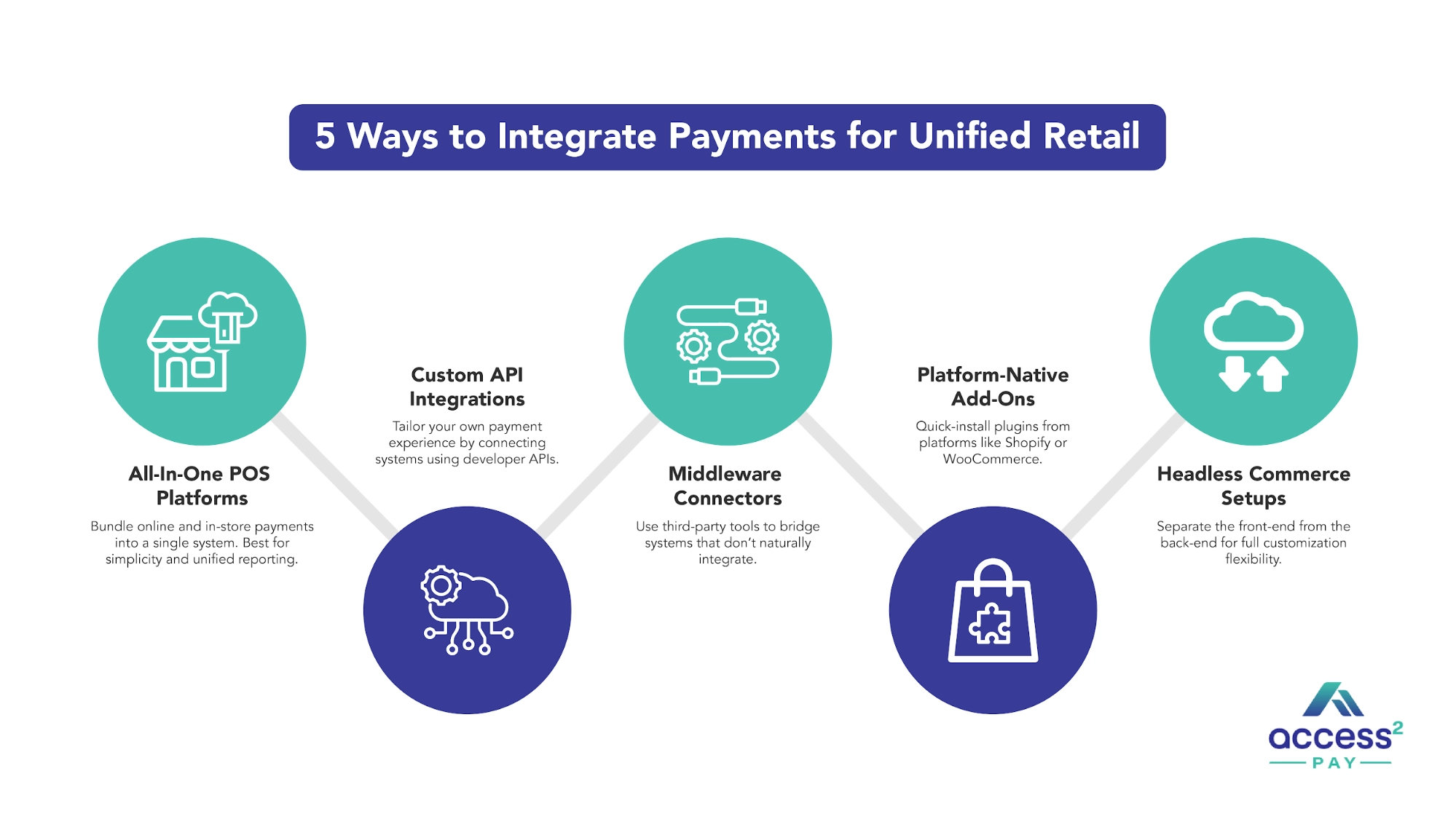
All-In-One POS Platforms
These systems bundle both in-store and online payment tools into a single ecosystem. You get unified dashboards, inventory syncing, and streamlined customer management. They’re ideal for businesses that want to avoid juggling multiple vendors, although you may face limitations in terms of integrations or feature customization.
Custom API Integrations
This approach is best suited for businesses that need tight control and specific workflows. APIs allow you to connect different tools, such as your e-commerce backend, accounting software, and CRM, into a seamless payment environment. It requires developer time and technical oversight, but the result is often a truly tailored system.
Middleware Connectors
These third-party tools act like translators between your payment processor and the rest of your tech stack. They’re especially useful if you’re dealing with legacy systems or non-standard platforms. Middleware saves time, though it can sometimes introduce delays or limit deeper functionality depending on the provider.
Platform-Native Add-Ons
Most major e-commerce platforms like Shopify, BigCommerce, or WooCommerce offer add-ons or plugins that connect directly to leading gateways. They’re easy to activate and usually well-maintained, yet may lack the flexibility of a more custom integration. These work well for businesses that prioritize speed and simplicity over full customization.
Headless Commerce Setups
If you’re running a larger operation or want to decouple the front-end from the back-end entirely, headless setups give you maximum flexibility. You can use one system for user experience and another for processing transactions. It’s more complex to manage, though it enables custom flows and integrations that would be difficult in a traditional setup.
Choosing the Right E-Commerce Payment Integration for Your Business
It’s tempting to look at features first. Or pricing. And before you dive into those details, you’ll want to think bigger. What role will your payment system play in your business a year from now? Maybe even three years from now?
Think about the long-term business impact before choosing a gateway:
- Growth-Ready Functionality: Choose a solution that won’t box you in as you add new products, locations, or markets.
- Technical Compatibility: Consider how easily the solution integrates with your current software, CRM, or ERP.
- Operational Overhead: Some systems require manual workarounds, while others automate reporting and inventory sync. Factor in that time.
- Transaction Fees and Flexibility: A lower rate might look good at first glance, yet hidden costs like setup or monthly fees can add up over time.
- Support and Reliability: What happens if something breaks during a sale? Is support available when you need it?
Your payment gateway integration shouldn’t just process transactions. It should help you run a smarter, more connected business.
Finding the Best Payment Integration Solution for Omnichannel Retail
Running a true omnichannel retail setup means you don’t treat online and in-person sales as separate departments. The goal is a fluid experience, not just for customers, but for staff and operations too. That’s where smart payment integration comes in. It’s the connective tissue that makes it all feel like one brand, one system, one unified experience, internally and externally.
This is more than syncing transactions. It’s about building a dependable operational core that supports consistent customer expectations, smooth processes, and real-time visibility across every channel. Without it, things unravel, duplicate records, mismatched inventory, and confused staff or customers. With it, everything clicks.
Centralized Dashboards
Track sales, refunds, and inventory movements from one place instead of juggling tabs. This helps you cut down on manual reporting and prevents errors that typically arise when switching between disconnected systems.
Consistent Customer Experience
From promo codes to gift cards, customers expect them to work everywhere, not just online. A consistent experience boosts confidence and encourages repeat business. It also eliminates awkward interactions like, “Sorry, that coupon only works online.”
Loyalty Program Compatibility
If someone earns points in-store, they want to redeem them online. Integration enables this fluidity and helps you create an omnichannel loyalty experience that actually feels rewarding, not restrictive or limited.
Employee Efficiency
Your team doesn’t need to learn multiple checkout systems. Training is faster, errors drop, and staff can shift between locations or roles without a learning curve. That kind of consistency is a quiet game-changer.
Data-Driven Decision-Making
With a unified system, you can identify trends across all channels and plan accordingly. You can spot high-performing products, customer behaviors, and timing patterns that help you stock smarter and promote more effectively.
A system that works together behind the scenes allows your front-line staff to focus on serving customers, not troubleshooting tech. And honestly, that’s what makes retail feel professional and personalized at the same time.
Key E-Commerce Payment Solutions for Seamless Transactions
There’s no single winner when it comes to payment gateway integration. What works for a subscription box company might not work for a luxury boutique. Still, a few solutions have emerged as strong choices depending on your needs.
Here are a few of the most commonly adopted gateways:
- Stripe: Ideal for businesses looking for customization through APIs. Popular with developers, scalable for startups and enterprises.
- Square: Good for smaller retailers or those who started in physical locations and are now moving online. Simple interface, reliable reporting.
- PayPal Commerce Platform: Broad name recognition and easy checkout. Suitable for businesses that want to appeal to a wide demographic.
- Shopify Payments: A natural choice for businesses already using Shopify. Integrates deeply with the platform’s features.
- Moneris: Canadian businesses often look here for localized support. Integrates well with many POS platforms and has strong fraud protection.
Each of these options offers some level of omnichannel capability, though the depth of integration varies.
Comparing E-Commerce Payment Options for Flexibility and Security
Before making a decision, it’s helpful to look at how leading solutions perform when it comes to two essential aspects: flexibility and security. Flexibility refers to how easily a solution can adapt to your existing systems and future needs. Security, meanwhile, is all about protecting transaction data, both for your customers and your business.
Here’s a table comparing five widely used payment gateway options:
| Payment Solution | Flexibility Level | Security Features | Ideal Use Case |
| Stripe | High | PCI compliance, tokenization | Businesses needing API-based custom setups |
| Square | Medium | End-to-end encryption | Retailers with both in-store and online shops |
| PayPal Commerce Platform | Medium | Buyer and seller protection | Businesses targeting international markets |
| Shopify Payments | Medium | 3D Secure, fraud analysis | Shopify-based online stores |
| Moneris | High | EMV, end-to-end encryption | Canadian businesses seeking local support |
You might notice some overlap in features, yet each gateway handles security a little differently:
- PCI Compliance: Required by all major gateways, it ensures the gateway meets industry standards for processing and storing payment data.
- Tokenization: Instead of storing sensitive data, systems like Stripe replace card details with a unique token, limiting exposure to fraud.
- End-To-End Encryption: This protects the entire transaction journey, from the point of sale to the processor.
- 3D Secure: Adds an extra layer of authentication during checkout, helping to prevent unauthorized transactions.
- Buyer and Seller Protection: Platforms like PayPal offer coverage for both parties in case of disputes, which can be helpful in high-volume, high-risk transactions.
- EMV Compliance: Common in physical card transactions, EMV chips add dynamic authentication that’s difficult to replicate.
Evaluating security features is just as important as ease of use. In fact, maybe even more so, especially as fraud continues to evolve. Choose a platform that fits your business needs today, while preparing for the threats of tomorrow.
FAQ
What Is Payment Gateway Integration?
It’s the process of connecting your website, mobile app, or in-store system with a payment processor so that transactions can be securely completed in real time. This connection allows businesses to accept various payment types, including credit cards, digital wallets, and even bank transfers. In practice, it’s what enables a seamless checkout experience, encrypts customer payment data, and ensures that funds move quickly and securely to your business bank account.
How Does Integration Benefit Retailers With Both Online And In-Person Stores?
Integration eliminates data silos by syncing inventory, customer records, and sales information between your e-commerce platform and physical POS. This means customers can buy online and return in-store, or pick up items purchased on your website, without creating operational headaches. It also helps your staff make better decisions because they can view real-time data from every touchpoint, improving both speed and customer satisfaction.
Which Payment Gateway Should I Choose For My Small Business?
The right choice depends on how you sell, who your customers are, and how much technical complexity you’re comfortable managing. If you’re just getting started or want something that works out of the box, Square is often the easiest path due to its built-in hardware, simple pricing, and easy setup. If you want more control or plan to expand into global markets or subscriptions, you might consider Stripe or PayPal Commerce Platform. It’s worth comparing a few options based on your growth goals and operational needs.
Final Thoughts
At the heart of omnichannel retail is one idea: your customers should feel like your business is one brand, no matter how they shop. Payment gateway integration helps make that happen. It smooths out back-end processes, connects online and in-store sales, and provides your team with fewer technical headaches to manage.
If you’re planning to grow, adding new locations, launching promotions, or scaling e-commerce, now’s the right time to choose a solution that fits long-term. The right integration doesn’t just move money. It moves your business forward.