In today’s digital economy, PCI-DSS compliance defines the standard for secure payment processing across industries, including government transactions. As digital payment systems expand, compliance is no longer a formality; it is a foundation for trust, accountability, and security. This article explores what PCI-DSS compliance means for Canadian government payments, its core requirements, challenges, benefits, and how platforms like Access2Pay help organizations meet these evolving standards with confidence and transparency.
Key Takeaways:
- PCI-DSS compliance strengthens data protection and builds public trust in digital payment systems.
- Canadian government entities face unique challenges in meeting PCI-DSS requirements due to complex systems and multi-level data access.
- Access2Pay simplifies PCI-DSS compliance through secure integrations, continuous monitoring, and government-ready payment solutions.
Understanding PCI-DSS Compliance for Canadian Government Payments
PCI-DSS stands for “Payment Card Industry Data Security Standard”, a global framework that governs how organizations handle cardholder information. For the Canadian government and its agencies, PCI-DSS compliance plays a central role in ensuring that every transaction, from licensing to public service payments, meets rigorous standards for security and accountability. Each institution handling card data must adhere to these standards, regardless of transaction volume or technical infrastructure.
In Canada, government entities operate within a multi-tiered environment where data moves through federal, provincial, and municipal systems. This complexity increases exposure to potential breaches, making PCI-DSS compliance vital for protecting citizens’ information. The framework provides structured guidance on encryption, access control, and monitoring mechanisms to reduce vulnerabilities within these networks.
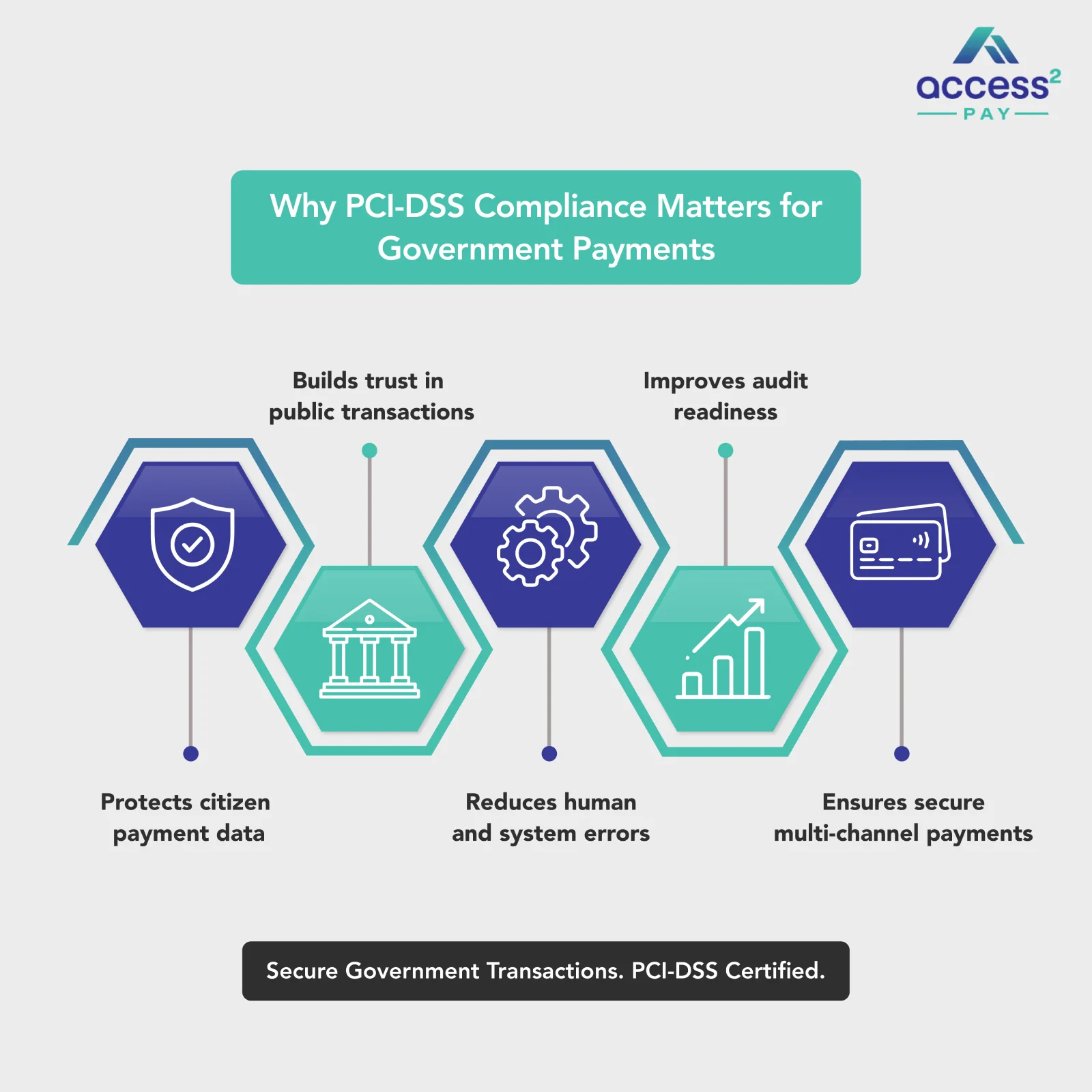
Beyond simply protecting card data, PCI-DSS compliance reinforces public confidence in digital governance. Citizens expect their financial information to be handled with precision and care. Government payment processors that follow these standards demonstrate transparency, regulatory responsibility, and proactive risk management. By aligning with PCI-DSS, they contribute to a safer, more connected financial ecosystem for Canada’s future.
Key PCI-DSS Compliance Requirements in Canada
Understanding the PCI-DSS compliance requirements is the first step in building a secure foundation for payment operations. The standard is composed of 12 main principles, but several requirements stand out for Canadian government use cases, particularly where sensitive citizen data is at stake.
1. Secure Network Configuration
Every payment system must be built on a secure network infrastructure that includes firewalls and intrusion prevention tools. Government payment processors should implement layered network defenses to restrict unauthorized access and segment sensitive environments. This setup minimizes the risk of data leakage or unauthorized system modifications. For comparison, retail payment providers using platforms like Access2Pay vs Clover POS follow similar principles for private-sector compliance.
2. Encryption of Cardholder Data
Cardholder data must always be encrypted during storage and transmission. For government entities, this includes encrypting data between internal systems, third-party processors, and cloud environments. Encryption keys should be stored securely, with rotation schedules to prevent unauthorized decryption. This level of encryption aligns with the privacy expectations outlined in Canadian data protection laws.
3. Access Control and Authentication
Access control ensures that only authorized personnel can handle sensitive data. This involves multi-factor authentication, role-based permissions, and detailed access logs. In a government setting, this step is critical for maintaining accountability across multiple departments and service providers. It also supports traceability during compliance audits and investigations.
4. Regular Monitoring and Testing
PCI-DSS compliance in Canada demands continuous monitoring of network activity and regular system testing. Tools for intrusion detection, vulnerability scanning, and penetration testing must be in place. Ongoing testing ensures early identification of weak points, helping public institutions prevent breaches before they occur.
5. Information Security Policies
A strong information security policy defines how payment data is managed and protected. Government agencies should maintain up-to-date documentation outlining all procedures, training programs, and responsibilities. These policies guide teams through incident response protocols and compliance reporting, aligning with PCI DSS compliance audit requirements.
How PCI Compliance Protects Government Payment Data
When discussing PCI compliance, it’s essential to understand how it safeguards government payment environments. Every rule within the PCI-DSS framework exists to prevent a specific type of threat, from unauthorized access to internal mishandling of information.
1. Reducing Data Breach Risks
Data breaches often occur when sensitive information is stored or transmitted without adequate safeguards. PCI-DSS standards require strong encryption, access control, and activity monitoring to prevent such breaches. For example, systems that adopt cloud-based payment gateway security protocols significantly reduce exposure to external threats. By enforcing secure communication channels, governments ensure that personal and financial data remain protected throughout the transaction process.
2. Ensuring Data Integrity
PCI compliance guarantees that data remains consistent and unaltered between systems. Through verification processes and checksum validation, it helps detect tampering attempts. For large-scale public systems that process tax or licensing payments, maintaining data integrity is essential for operational accuracy. The integration of real-time payment processing further ensures that payments are validated instantly, reducing reconciliation delays and potential data mismatches.
3. Enhancing Accountability and Traceability
PCI-DSS standards promote transparency through strict audit trails and event logging. Each transaction and access attempt can be traced back to specific users or departments. This helps government entities identify irregular activities quickly. By integrating automated logging solutions, similar to those used in integrated payment software, public institutions improve oversight without compromising efficiency.
The Role of PCI-DSS Compliance Audits in Government Transactions
Audits form the backbone of PCI-DSS compliance verification. A PCI-DSS compliance audit evaluates whether systems, controls, and processes align with global payment security standards. For Canadian government agencies, these audits are crucial for maintaining accountability and ensuring the continuous protection of citizen data.
The PCI DSS compliance audit process involves reviewing system architecture, encryption mechanisms, access management, and monitoring tools. Auditors assess compliance readiness through technical testing, interviews, and document evaluations. These findings help institutions identify gaps and create remediation plans before submitting validation reports to relevant authorities.
Regular audits also encourage operational discipline and long-term compliance culture. Instead of viewing audits as yearly checkboxes, government organizations can use them as continuous improvement tools. By addressing vulnerabilities proactively, they protect against both internal errors and sophisticated cyberattacks that target public infrastructure.
PCI Compliance Challenges Unique to the Canadian Public Sector
The Canadian public sector faces distinct challenges when implementing PCI compliance due to its diverse data environments, legacy systems, and inter-departmental structures.
1. Integration with Legacy Infrastructure
Many government systems were designed long before PCI-DSS existed. These legacy platforms often lack encryption support and require specialized integrations. Upgrading them involves coordination between departments and external vendors, which can extend compliance timelines. Solutions like integrated payment systems help bridge this gap by enabling compatibility with older architectures.
2. Decentralized Data Management
Unlike private enterprises, government agencies often operate in silos. Different departments manage their own payment systems, resulting in inconsistent security protocols. Implementing centralized PCI-DSS standards across such diverse structures requires strong leadership and inter-agency collaboration. This challenge emphasizes the importance of unified governance strategies in the public sector.
3. Limited Security Budgets
Budget constraints can limit access to specialized cybersecurity tools or consultants. Smaller municipalities, in particular, may lack dedicated IT teams. Collaborating with compliant service providers such as Access2Pay helps these entities adopt ready-made PCI-DSS frameworks without large upfront costs. This partnership approach ensures compliance without compromising financial efficiency.
Benefits of PCI-DSS Compliance for Government POS Systems
Government payment systems that comply with PCI-DSS gain more than regulatory approval; they achieve sustainable trust and improved operational control.
1. Strengthened Data Protection
Compliance ensures that sensitive cardholder data is encrypted, stored securely, and handled responsibly. Government entities processing payments for services such as utilities or licenses benefit from reduced fraud risks. POS security solutions further reinforce this protection, integrating advanced monitoring systems that detect unauthorized activities in real time.
2. Improved Public Confidence
Citizens are more likely to trust online payment portals when they know their data is secure. PCI-DSS certification serves as a visible signal of that commitment. For example, platforms adhering to PCI compliance Canada standards assure users that strict security protocols are in place, which in turn encourages adoption of digital payment channels.
3. Operational Efficiency and Cost Savings
By automating compliance tasks such as logging, reporting, and risk assessments, agencies save valuable resources. Automation also reduces the likelihood of human error during payment handling. Solutions like Access2Pay’s multi-channel payment management bring these capabilities under one dashboard, enabling seamless compliance oversight.

How Access2Pay Ensures PCI Compliance for Government Businesses
Access2Pay builds its technology around the principle of secure, compliant payments for both private and public sectors. Every component of its system, from data storage to reporting, aligns with PCI DSS compliance requirements to ensure full protection of sensitive data.
The platform integrates encryption, access control, and continuous monitoring tools into every payment channel. This helps government agencies meet security standards without relying on multiple third-party vendors. By offering an all-in-one payment system, Access2Pay eliminates common compliance risks associated with fragmented solutions.
Additionally, Access2Pay conducts periodic system reviews to validate alignment with DSS compliance mandates. Its in-built analytics dashboard allows administrators to track compliance status, detect anomalies, and generate audit-ready reports instantly. This proactive approach reduces audit preparation time and maintains year-round data integrity.
FAQ
What is PCI-DSS compliance?
PCI-DSS compliance refers to the global standards that govern how organizations handle credit card data securely. It was established by major card networks to prevent fraud and data breaches. These standards include encryption, network protection, and regular monitoring. For the Canadian government, compliance ensures safe handling of payments for public services.
Why is PCI-DSS compliance important for Canadian government payments?
Government transactions involve sensitive citizen data that must remain secure at all times. PCI-DSS compliance helps prevent unauthorized access, data theft, and payment fraud. It also builds trust among citizens who rely on digital government services. Compliance signals a government’s commitment to modern, responsible financial management.
How often should PCI-DSS audits be conducted?
Audits should occur at least once annually or after major infrastructure changes. Regular audits identify weaknesses, verify controls, and confirm compliance readiness. For government agencies, audits ensure continuous accountability. Consistent auditing strengthens resilience against evolving cyber threats.
What is PCI compliance Canada?
What is PCI compliance Canada refers to how Canadian entities, including government institutions, adopt PCI-DSS standards under national regulations. It encompasses encryption, secure network design, and employee training. Meeting these requirements protects cardholder data and ensures alignment with federal privacy laws.
Future-Proofing Payments with PCI-DSS Compliance
The payment landscape continues to evolve, driven by digital transformation and public demand for secure online services. PCI-DSS compliance ensures that Canada’s government agencies remain prepared for this future, balancing innovation with responsibility. As new technologies like AI-driven analytics and blockchain enter the payment ecosystem, compliance frameworks will adapt to safeguard every interaction.
By prioritizing security, transparency, and accountability, government payment systems will continue to gain citizen trust and operational strength. With solutions like Access2Pay, agencies can confidently meet compliance requirements while advancing toward a secure digital future grounded in PCI-DSS compliance.