Property tax payments are a lifeline for local governments, funding schools, infrastructure, and public services. Yet even well-structured systems face risks that delay revenue, create compliance issues, or disrupt cash flow. Governments often underestimate these risks, assuming transactions will flow smoothly. Understanding where vulnerabilities exist is critical to ensuring accuracy, accountability, and public trust in property tax payment systems.
Key Takeaways
- Property tax payment systems face hidden revenue timing risks, including delays, surges, and reconciliation gaps.
- System accuracy challenges, such as data errors, valuation mismatches, and legacy system failures, can compromise payments.
- Interdepartmental coordination and proactive mitigation strategies are essential to reduce risk and maintain cash flow reliability.
Hidden Revenue Timing Risks in Property Tax Payment
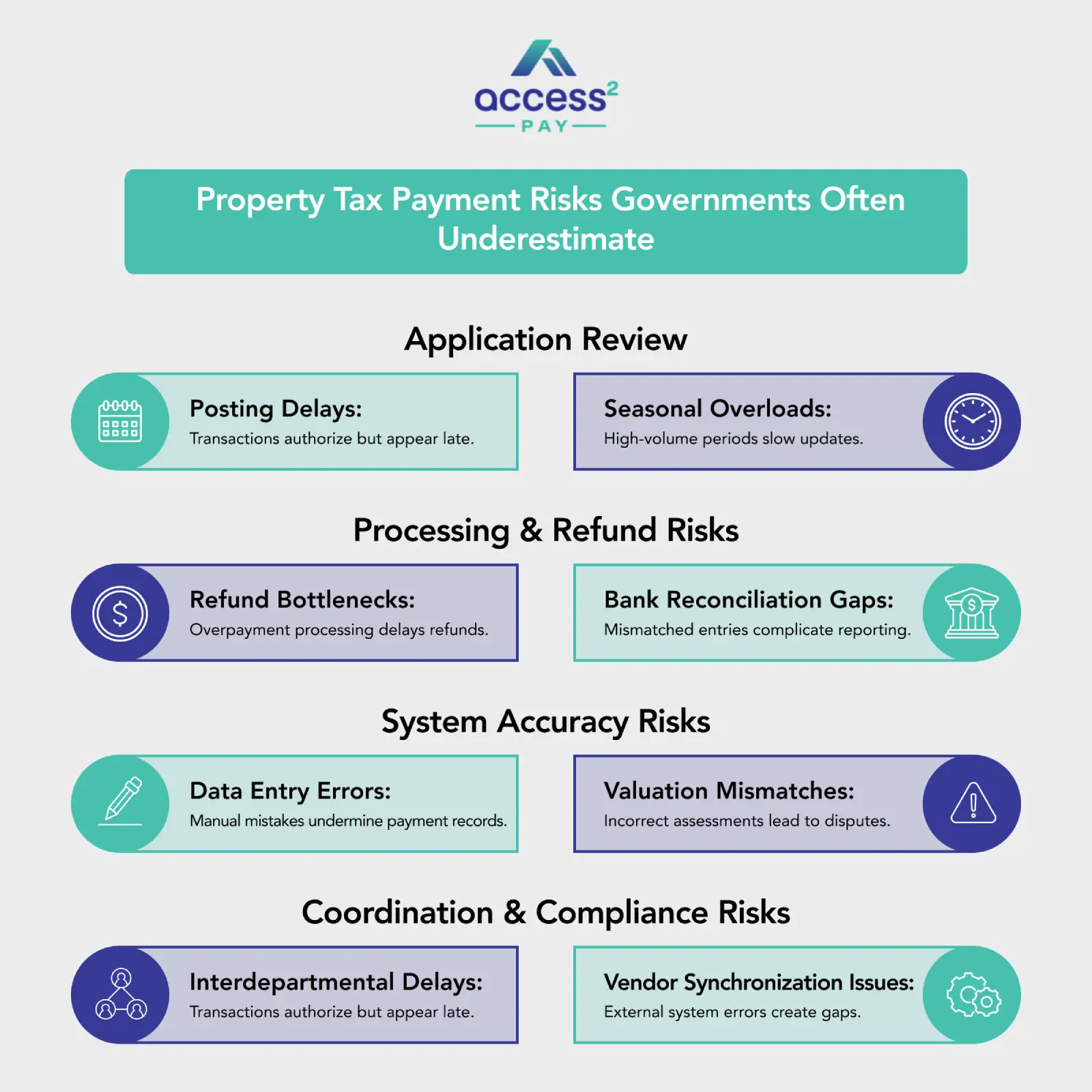
Revenue timing is a subtle yet impactful risk in property tax payment systems. Even when taxpayers submit fees on time, delays in posting, reconciliation, or synchronization can create gaps in projected revenue. These timing issues affect financial planning, cash flow projections, and public service funding schedules.
Posting Delays Impacting Property Tax Payment Revenue
When payments are authorized but not immediately posted to the ledger, governments face temporary gaps in reported revenue. These delays may seem minor, but they can accumulate during high-volume periods, creating inaccurate budget forecasts and potentially impacting services dependent on timely funding.
Best Practices:
- Implement real-time posting mechanisms and see to it that all payments are reflected instantly in financial records.
- Track pending and settled payments separately to monitor cash flow accurately.
Seasonal Surge Overloads in Property Tax Payment
Property tax deadlines often coincide with peak payment seasons. Systems may struggle to process high volumes of transactions simultaneously, leading to delayed updates and frustrated taxpayers.
Best Practices:
- Anticipate seasonal peaks with stress testing and capacity planning.
- Use load-balancing technology to manage spikes and maintain system responsiveness.
Refund Processing Bottlenecks for Property Tax Payment
Refund requests, even if it’s due to overpayment or corrected valuations, can create bottlenecks in payment processing. Slow refund cycles erode taxpayer confidence and burden staff with repeated inquiries.
Best Practices:
- Automate refund workflows with clear validation rules.
- Track refund requests in dashboards to quickly identify delays or exceptions.
Bank Reconciliation Gaps in Property Tax Payment
Even after payments post successfully, reconciliation with bank statements can lag. Mismatched transactions, duplicate entries, or failed settlements can leave gaps that complicate financial reporting.
Best Practices:
- Schedule automated reconciliation routines daily.
- Cross-check ledger entries against bank feeds to catch discrepancies early.
Installment Payment Synchronization Issues
Many taxpayers pay property taxes in installments. Synchronizing multiple installment payments with the ledger can be challenging, particularly when payments arrive via different methods.
Best Practices:
- Use a centralized tracking system to consolidate installment payments.
- Automatically update taxpayer accounts to reflect partial and full payments.
Cash Flow Projections Affected by Property Tax Payment Risks
Unforeseen delays in processing payments or reconciliations directly impact projected revenue streams. Misaligned cash flow forecasting can disrupt municipal operations, from school funding to infrastructure projects.
Best Practices:
- Build risk-adjusted projections that account for delayed postings and refunds.
- Monitor real-time cash positions to respond quickly to any shortfalls.
System Accuracy Challenges in Property Tax Payment
Accurate systems underpin trust in property tax payment processes. Even minor data entry errors or system bugs can compound across thousands of transactions, creating material gaps in revenue or compliance.
Data Entry Errors Undermining Property Tax Payment
Manual input errors, such as incorrect addresses, tax amounts, or property identifiers, remain a significant source of inaccuracies. Even simple mistakes can require labor-intensive corrections.
Best Practices:
- Implement automated field validation to catch errors before submission.
- Encourage double-entry verification for critical fields.
Valuation Mismatches During Property Tax Payment
Property valuations directly affect tax amounts. Errors in assessment data, even if it’s because of outdated information or misapplied formulas, can result in incorrect charges, delays, or disputes.
Best Practices:
- Sync assessment data with payment systems regularly.
- Flag discrepancies automatically and require review before final payment acceptance.
Duplicate Transaction Risks in Property Tax Payment
Duplicate payments may occur due to system errors, repeated submissions, or manual overrides. Duplicate entries strain accounting workflows and create taxpayer frustration.
Best Practices:
- Use unique transaction identifiers for every payment.
- Implement automatic duplicate detection and alert mechanisms.
Legacy System Failures in Property Tax Payment
Older financial systems often lack integration and real-time reporting. Legacy software can fail under high transaction volumes, causing delays or processing errors.
Best Practices:
- Upgrade legacy systems with modern, cloud-based platforms.
- Integrate legacy data into new systems to maintain historical continuity.
Audit Trail Inaccuracies for Property Tax Payment
A complete audit trail is essential for accountability and compliance. Inaccuracies or gaps in the trail reduce transparency and complicate audits.
Best Practices:
- Guarantee all payments, reversals, and adjustments are logged with timestamps.
- Use centralized audit logs that are immutable and accessible for verification.
Integration Bugs Compromising Property Tax Payment Accuracy
Errors can arise when payment systems fail to communicate with finance, enforcement, or reporting platforms. These integration bugs can create mismatched data, double postings, or missed transactions.
Best Practices:
- Conduct regular testing of integrations between departments.
Monitor system logs to detect and resolve anomalies proactively.
Interdepartmental Coordination Risks in Property Tax Payment
Processing property tax payments requires coordination across multiple departments, from finance to enforcement. Gaps in communication or delayed handoffs can escalate into significant inefficiencies.
Handoff Delays Between Departments for Property Tax Payment
When payment processing moves between departments, slow handoffs can delay posting and reconciliation. Departments may wait for approvals, slowing down the overall workflow.
Best Practices:
- Standardize interdepartmental protocols to reduce delays.
- Automate handoffs wherever possible to maintain real-time updates.
Communication Gaps in Property Tax Payment Workflows
Miscommunication between departments or unclear processes can lead to repeated inquiries, delayed reporting, and frustrated staff.
Best Practices:
- Implement centralized communication dashboards.
- Schedule regular cross-department check-ins to resolve pending issues.
Enforcement-Accounting Disconnects in Property Tax Payment
When enforcement teams and accounting systems operate independently, discrepancies in payment status may arise. This can affect collections and legal compliance.
Best Practices:
- Integrate enforcement and accounting platforms to stabilize synchronized updates.
- Provide real-time access to payment status for both departments.
Compliance Review Backlogs Affecting Property Tax Payment
Compliance checks, such as verifying exemptions or special assessments, can create backlogs if reviews are manual or inconsistent.
Best Practices:
- Automate compliance checks where possible.
- Prioritize high-value or high-risk cases to maintain efficiency.
Vendor Synchronization Issues in Property Tax Payment
If third-party processors or payment gateways fail to sync with government systems, transactions can be delayed or lost.
Best Practices:
- Require vendors to follow standardized data formats and real-time sync protocols.
- Conduct regular vendor audits to verify system integrity.
Escalation Protocol Failures for Property Tax Payment Risks
Without clear escalation paths, issues such as failed payments or disputes may linger unresolved, creating risk exposure.
Best Practices:
- Establish formal escalation protocols for delayed or failed transactions.
- Train staff to recognize and escalate high-priority issues immediately.

Mitigation Strategies for Property Tax Payment Risks
Effective mitigation combines technology, training, and process improvements. Governments that proactively address property tax payment risks can reduce delays, improve cash flow, and maintain public trust.
Real-Time Monitoring for Property Tax Payment Revenue
Continuous monitoring secures early detection of delays, failed transactions, or anomalies.
Best Practices:
- Use dashboards for finance teams to track payments in real time.
- Set automated alerts for missed or delayed transactions.
Automated Validation Tools in Property Tax Payment
Automation reduces errors by validating entries against rules and previous payments.
Best Practices:
- Implement automated checks for duplicate payments, incorrect amounts, or invalid accounts.
- Use system prompts to guide staff in error correction.
Cross-Department Training on Property Tax Payment Risks
Training confirms that all staff understand workflows, common errors, and escalation protocols.
Best Practices:
- Schedule recurring training sessions for new and existing staff.
- Use real-world scenarios to practice resolving common issues.
Scenario Planning for Property Tax Payment Peaks
Planning for seasonal peaks reduces processing delays and system strain.
Best Practices:
- Simulate high-volume scenarios to identify bottlenecks.
- Prepare contingency plans, such as additional staff or server capacity.
System Upgrades Enhancing Property Tax Payment Accuracy
Modernizing legacy systems improves speed, accuracy, and integration.
Best Practices:
- Upgrade to cloud-based platforms with real-time synchronization.
- Guarantee strong security protocols to protect taxpayer data.
Regular Audits to Uncover Property Tax Payment Vulnerabilities
Audits reveal weak points in processes, controls, or systems.
Best Practices:
- Conduct audits regularly and document findings.
- Implement corrective measures immediately for identified gaps.
FAQ
What happens if my property tax payment doesn’t post immediately?
Sometimes payments authorize but posting takes additional time. Systems update once settlements are confirmed. Monitoring dashboards can help track pending payments. Staff can quickly intervene if discrepancies persist, ensuring your account remains accurate.
Can governments reduce delays with installments?
Yes, installment schedules require synchronization to prevent mismatched entries. Automated reminders and tracking reduce errors. This ensures taxpayers and finance teams both see consistent account balances in real time.
How are duplicate property tax payments handled?
Duplicate payments trigger system alerts and require reconciliation. Refunds or credit adjustments secure accuracy. Timely detection prevents accounting errors. Automated systems also flag potential duplicates before posting, minimizing manual intervention and reducing delays.
Understanding Property Tax Payment
Governments depend on property tax payments for core funding, yet even minor errors or delays can cascade into significant operational issues. By identifying risks, implementing automated validation, and maintaining cross-department visibility, agencies can streamline processing, safeguard revenue, and maintain public trust in the system.