
Building permit fee payment systems sit at the center of regulatory enforcement, revenue collection, and project enablement. When these systems perform well, construction timelines stay predictable and government revenue flows cleanly. When they falter, delays ripple outward into inspections, approvals, audits, and public confidence.
Most payment failures do not appear as outright breakdowns. They surface as timing gaps, misalignments between systems, or small calculation errors that compound under volume. Monitoring these risks early allows governments to stabilize operations before friction becomes visible to applicants or leadership.
This article breaks down five building permit fee payment risks that consistently undermine performance, explaining how they surface, why they persist, and what they cost when left unmanaged.
Key Takeaways
- Building permit fee payment risk often emerges from timing and coordination failures rather than missing funds
- Posting, reconciliation, and system handoffs create more disruption than payment authorization itself
- Proactive monitoring reduces manual workload, audit exposure, and applicant frustration
Operational Impact and Revenue Loss from Building Permit Fee Payment Risks
Building permit fee payment reliability shapes how well permitting, inspections, and enforcement function day to day. When payment workflows lose predictability, operational stability degrades across departments.
Operational impact appears first, revenue impact follows.
Where Operational Disruption Begins
Payment instability quickly affects workflows beyond finance:
- Permit issuance delays
Payment status uncertainty prevents permits from advancing even after funds are authorized. - Inspection scheduling disruptions
Inspectors pause scheduling when systems cannot confirm payment completion reliably. - Contractor and applicant uncertainty
Inconsistent status signals force applicants to delay work, resubmit payments, or contact support. - Manual workarounds across departments
Staff bypass systems through emails, spreadsheets, and verbal confirmations to keep work moving.
Each workaround increases effort while reducing visibility.
How Revenue Loss Actually Manifests
Revenue loss rarely appears as missing funds. It shows up as friction and delay:
- Delayed revenue recognition
Funds exist but remain unposted, distorting cash flow and reporting. - Misallocated or misclassified payments
Errors spread across funds, programs, or fiscal periods. - Refund and adjustment backlogs
Overpayments and corrections hold revenue in limbo. - Audit findings and remediation cycles
Staff time shifts from service delivery to documentation and correction.
These losses accumulate quietly, often unnoticed until reporting cycles or audits.
Compounding Effects Over Time
Unaddressed payment risk compounds operational strain:
- Exception handling replaces standard processing
Staff spends more time fixing errors than advancing permits. - Reporting confidence declines
Leadership decisions rely on incomplete or outdated financial snapshots. - Support volume increases
Applicants escalate inquiries when the status remains unclear. - Temporary fixes become permanent
Manual processes harden into unofficial workflows.
Each peak period re-exposes the same weaknesses at greater scale.
Impact on Public Trust and Compliance
Operational friction influences public confidence:
- Applicants interpret delays as inefficiency
Even when payments succeed, unclear confirmation erodes trust. - Appeals and disputes increase
Inconsistent records drive enforcement challenges. - Compliance actions lose credibility
Enforcement based on stale data triggers unnecessary citations.
Trust declines through repetition, not singular failure.
Why Early Visibility Matters
Payment risks remain manageable when surfaced early:
- Clear timing controls prevent downstream disruption
- Cross-system visibility reduces manual intervention
- Proactive monitoring limits correction workload
- Predictable workflows stabilize permit operations
When payment flows guide users cleanly from submission to confirmation, operational strain falls across every department.

Risk 1 – Fee Accuracy Issues in Building Permit Fee Payment
Fee accuracy is the structural base of every building permit fee payment workflow. When calculation logic diverges from regulation, every downstream system inherits that misalignment. Revenue reporting distorts. Applicant trust weakens. Manual correction becomes routine rather than exceptional.
Accuracy failures rarely stem from a single mistake. They emerge when policy complexity outpaces system logic, when updates propagate unevenly, and when human input compensates for automation gaps. At scale, these weaknesses amplify across volume.
Calculation Errors Compromising Building Permit Fee Payment
Calculation engines convert regulatory language into executable rules. That translation introduces risk when policies include layered conditions, exceptions, and jurisdiction-specific modifiers. Zoning overlays, valuation thresholds, occupancy classifications, and phased development rules interact in ways that static logic struggles to represent.
Errors arise when:
- Regulatory updates occur faster than rule maintenance cycles
- Conditional dependencies conflict under edge cases
- Legacy rules persist alongside updated policies
Once calculation errors enter the system, they travel downstream. Applicants dispute charges. Staff intervene manually. Reconciliation becomes reactive rather than controlled. Under volume, even marginal miscalculations compound into significant operational drag.
Scope Change Miscalculations in Building Permit Fee Payment
Permit scope rarely remains static. Design revisions, occupancy changes, square footage adjustments, and material substitutions alter fee exposure throughout a project lifecycle. Systems that calculate fees once at intake assume stability that rarely exists.
Without automated re-evaluation triggers, scope changes rely on staff awareness and manual recalculation. That dependence introduces delay and inconsistency, especially when teams manage dozens of concurrent revisions. Fee accuracy declines precisely when workload intensifies and attention fragments.
Surcharge and Tax Discrepancies Affecting Building Permit Fee Payment
Building permit fees often include layered surcharges such as development levies, environmental contributions, regional assessments, and infrastructure offsets. These components change independently of base permit rates and often follow separate regulatory schedules.
When surcharge logic lags behind updates, total fee amounts fall out of alignment even if base calculations remain correct. These discrepancies rarely surface immediately. They emerge during reconciliation, audit preparation, or applicant appeals, long after funds have been collected and posted.
Manual Input Risks in Building Permit Fee Payment Systems
Despite automation, manual input remains unavoidable. Parcel identifiers, valuation figures, project descriptors, and exception flags still depend on human entry. Under deadline pressure, fatigue and repetition increase error probability.
Systems that assume manual perfection shift correction costs downstream. Validation layers must absorb human variability through structured checks, contextual prompts, and dependency rules. Without that protection, minor input errors trigger cascading reconciliation and support effort.
Historical Rate Updates Delaying Building Permit Fee Payment
Rate updates rarely align neatly with fiscal cycles or system deployment schedules. Mid-cycle changes require coordinated updates across calculation engines, applicant portals, finance systems, and reporting tools.
When updates lag, governments face retroactive corrections. Staff must adjust charges, issue refunds, or apply credits manually. These interventions consume time, create applicant frustration, and complicate audit trails. Timely propagation protects both accuracy and credibility.
Vendor Pricing Changes Impacting Building Permit Fee Payment
Payment processors periodically adjust transaction fees, interchange rates, and settlement structures. When pricing updates fail to synchronize with internal accounting logic, reconciliation mismatches emerge between gross collections and net deposits.
Transparent separation of permit fees and processing costs reduces confusion. Clear mapping simplifies audit review and prevents disputes over responsibility for fee variances.
Risk 2 – Posting Delays in Building Permit Fee Payment
Posting defines completion from the applicant’s perspective. Funds may authorize successfully while permit status remains unchanged. That gap erodes confidence quickly and generates avoidable support demand.
Posting delays rarely reflect payment failure. They reflect timing misalignment across authorization, settlement, reconciliation, and system synchronization. Without visibility into these stages, applicants assume error even when transactions succeed.
Batch Schedule Overruns for Building Permit Fee Payment
Batch posting consolidates transactions to maintain control and audit discipline. During high-volume periods, batch queues expand beyond planned windows as processing capacity falls behind intake.
As queues grow, financial ledgers understate collected revenue despite cleared funds. Finance teams lose real-time visibility precisely when volume peaks. Operational decisions rely on incomplete data, increasing risk exposure.
Bank Clearance Timelines Slowing Building Permit Fee Payment
Authorization confirms fund availability. Settlement confirms transfer completion. These steps follow different timelines based on payment method, banking windows, and clearing protocols.
Systems that wait for settlement before updating permit status create visibility gaps. Applicants see funds leave their account while portals continue to show unpaid status. That disconnect triggers inquiries, resubmissions, and escalations.
Status Visibility Gaps Post-Building Permit Fee Payment
Permitting, finance, inspection, and enforcement systems often update on different schedules. When one system reflects payment and another does not, inconsistent status views emerge across departments.
Applicants receive mixed signals through portals, emails, and notices. Staff then reconcile conflicting records manually. Status inconsistency becomes a communication problem rather than a financial one.
Volume Spikes Overloading Building Permit Fee Payment Posting
Construction cycles compress activity into narrow windows tied to seasonal deadlines and regulatory milestones. Posting throughput that performs adequately under average load falters under sustained concurrency.
Without load-aware prioritization, posting delays cascade across systems. High-value transactions wait behind low-impact updates. Queue expansion compounds delay rather than resolving it.
Error Review Queues Extending Building Permit Fee Payment
Posting exceptions require investigation. Each exception consumes staff attention and pauses transaction progression. When exception queues grow faster than resolution capacity, backlogs emerge.
Unresolved queues delay subsequent processing cycles and increase reliance on manual intervention. Over time, exception handling shifts from control mechanism to bottleneck.
Confirmation Notification Failures in Building Permit Fee Payment
Confirmation messages provide closure. They signal success and reduce uncertainty. During peak periods, notification infrastructure often competes with core processing resources.
When confirmations delay or fail, applicants retry submissions or contact support. Duplicate payments, reconciliation complexity, and refund requests follow. Clear, timely confirmation prevents unnecessary churn.

Risk 3 – System Handoff Problems for Building Permit Fee Payment
Building permit fee payment workflows rely on seamless handoffs between systems. Each handoff introduces latency, formatting risk, and dependency on uptime.
Permitting-to-Finance Integration Failures in Building Permit Fee Payment
Permitting systems initiate transactions. Finance systems recognize revenue. When integration breaks, both systems maintain conflicting truths.
Staff then reconcile manually, increasing error probability and workload.
Data Loss During Building Permit Fee Payment Transfers
Incomplete payloads, dropped fields, and transmission errors occur under load. Data loss requires reconstruction from logs and supporting documents.
Audit confidence declines when transaction chains lack continuity.
Departmental Sync Delays in Building Permit Fee Payment
Departments refresh data on different schedules. When updates lag, enforcement and inspection actions proceed based on outdated information.
Misalignment creates unnecessary citations and appeals.
API Interruptions Disrupting Building Permit Fee Payment
APIs coordinate real-time exchange. Interruptions break transaction chains and trigger retries.
Retry logic increases duplicate risk.
Legacy System Conflicts with Building Permit Fee Payment
Older platforms struggle with concurrency and modern security standards. Legacy constraints surface during peak demand.
Modernization reduces hidden bottlenecks.
Workflow Interruptions at Building Permit Fee Payment Handoffs
Workflow interruptions halt permit progression even after successful payment.
Applicants perceive failure despite completed transactions.
Risk 4 – Reconciliation Timing Challenges in Building Permit Fee Payment
Reconciliation is where confidence in building permit fee payment either solidifies or erodes. This stage confirms that what systems recorded, banks settled, and departments reported all align. Timing is the differentiator. When reconciliation runs too late, too infrequently, or without context, minor discrepancies expand into audit issues and operational noise.
Payment systems rarely fail outright at reconciliation. They fail quietly, through timing gaps that leave teams chasing mismatches long after the root cause has faded from view.
Ledger-Bank Matching Delays for Building Permit Fee Payment
Ledger-bank matching connects internal records with external settlement reality. Even when amounts match exactly, timing differences between authorization, posting, and settlement introduce apparent discrepancies. These mismatches appear as exceptions when systems lack the ability to distinguish timing variance from true failure.
When matching runs infrequently or without transaction-level context, finance teams spend time investigating payments that would have resolved naturally with proper classification. Early identification of timing-related variance reduces false alarms and keeps reconciliation effort focused on real risk.
Variance Detection Gaps in Building Permit Fee Payment
Variance detection acts as an early warning system. Automated detection identifies mismatches in amount, date, fund allocation, or transaction state before they cascade into reporting cycles. When detection runs late, discrepancies propagate across systems and periods.
Delayed variance recognition increases correction effort because:
- Related transactions may already be closed
- Period-end reporting may include unresolved balances
- Audit documentation must explain historical adjustments
The longer a variance remains unidentified, the more explanations it requires.
Multi-Fund Allocation Timing Issues in Building Permit Fee Payment
Building permit fees often distribute across multiple funds, such as general revenue, infrastructure reserves, environmental programs, or inspection services. Allocation logic must execute at the same moment payment posts, not days later during reconciliation.
Timing mismatches create temporary imbalances that confuse fund reporting and complicate audit trails. Automated, rules-based allocation at posting reduces exposure by ensuring each fund reflects accurate balances immediately, rather than relying on later adjustments.
Refund Processing Backlogs Affecting Building Permit Fee Payment
Refunds reverse previously recognized revenue. When refund workflows lag, systems temporarily overstate revenue and expose governments to reporting inaccuracies. Backlogs also increase applicant dissatisfaction and support inquiries.
Refund delays often stem from:
- Manual approval chains
- Incomplete transaction context
- Separate systems handling refunds and original payments
Automated refund routing tied to original transaction data shortens resolution time and limits financial distortion.
Period-End Cutoff Risks for Building Permit Fee Payment
Period-end cutoffs magnify reconciliation pressure. Payments submitted near cutoff dates may authorize within one period and settle in the next. Without clear cutoff rules, systems misclassify revenue across reporting periods.
Late postings distort financial statements and trigger retroactive corrections. Clearly defined cutoff policies, paired with timestamp-based classification, preserve reporting accuracy and reduce post-close adjustments.
Audit Preparation Delays from Building Permit Fee Payment Reconciliation
Audits depend on reconciliation completeness. Incomplete or late reconciliation forces audit teams to reconstruct transaction history instead of validating controls. That reconstruction increases scrutiny and prolongs audit cycles.
When reconciliation operates continuously rather than episodically, audit preparation becomes confirmation rather than investigation. Clean, time-aligned reconciliation shortens audits and strengthens confidence.
Risk 5 – Monitoring and Mitigation for Building Permit Fee Payment
Building permit fee payment risk does not disappear through policy alone. It becomes manageable through visibility, automation, and informed oversight. Monitoring converts static controls into living safeguards that adapt to volume, change, and pressure.
Effective mitigation focuses less on reacting to failures and more on detecting drift early.
Real-Time Alerts for Building Permit Fee Payment Anomalies
Real-time alerts surface abnormal behavior as it occurs rather than after reconciliation cycles complete. These alerts highlight deviations in volume, timing, amount, or workflow progression.
Effective alerting distinguishes between:
- Expected peak behavior
- Timing-related variance
- True processing failure
This distinction allows teams to respond proportionally rather than escalating every anomaly.
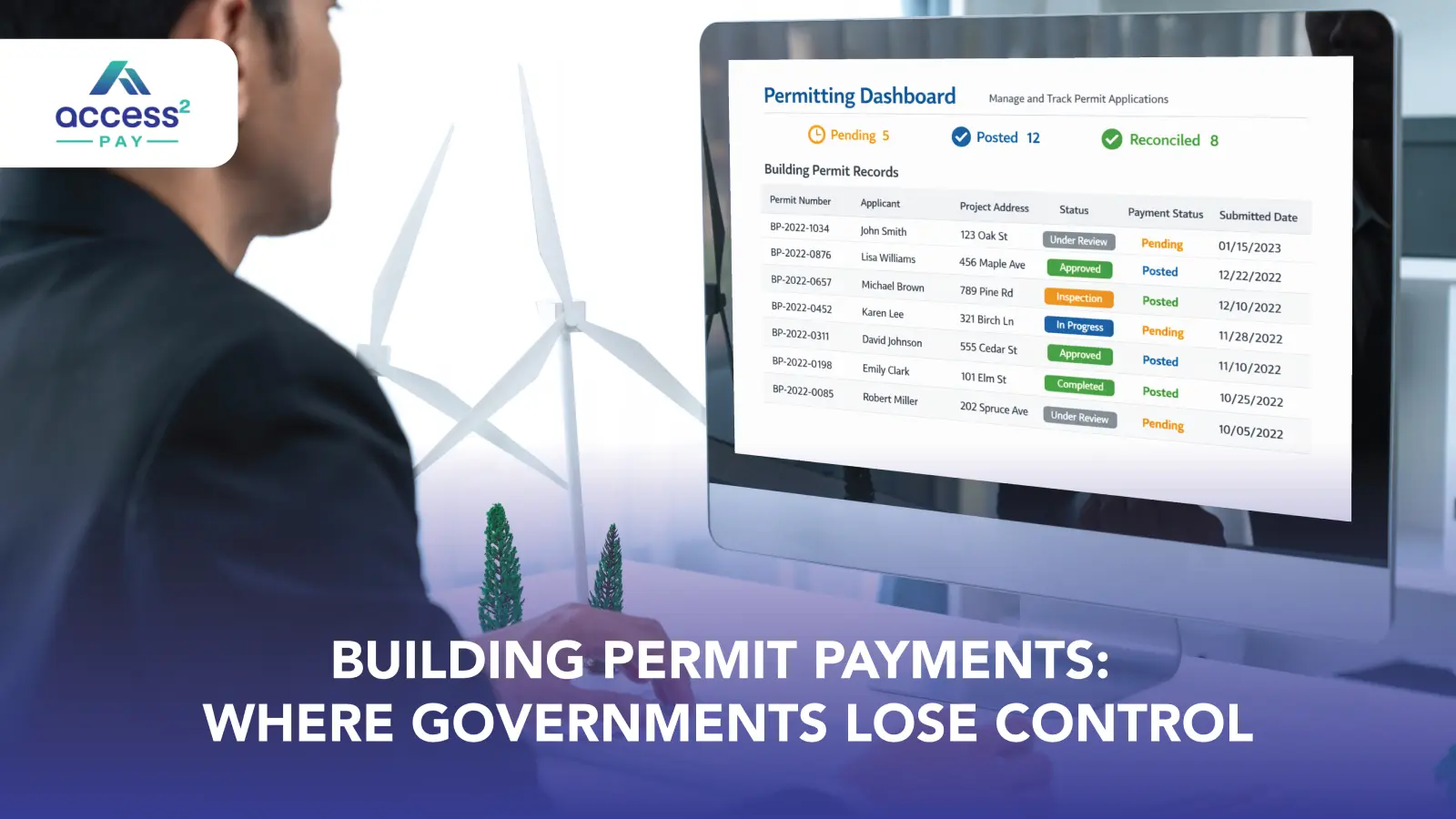
Dashboard Tracking of Building Permit Fee Payment Risks
Dashboards consolidate operational, financial, and system signals into a single view. They replace fragmented reports with real-time awareness. Leadership gains visibility into payment flow health without relying on anecdotal updates.
Well-designed dashboards track:
- Posting latency
- Exception queue growth
- Reconciliation completion rates
- Refund turnaround time
This visibility enables proactive intervention before risk escalates.
Automated Validation Tools in Building Permit Fee Payment
Validation tools prevent bad data from entering the system. These tools operate before posting, intercepting incorrect amounts, invalid classifications, or duplicate submissions.
Preventive validation reduces:
- Manual correction effort
- Refund volume
- Reconciliation noise
Stopping errors early costs less than correcting them after funds move.
Staff Training on Building Permit Fee Payment Indicators
Technology surfaces signals. Staff interpret them. Training ensures teams recognize patterns that indicate emerging risk rather than isolated anomalies.
Effective training focuses on:
- Understanding payment lifecycle stages
- Recognizing timing-related variance
- Knowing escalation thresholds
Human judgment remains a critical control layer.
Periodic Audits of Building Permit Fee Payment Processes
Audits validate that controls continue to function as designed. Periodic internal audits identify drift caused by system changes, policy updates, or volume growth.
These reviews reinforce discipline and provide early course correction without waiting for external scrutiny.
System Stress Testing for Building Permit Fee Payment Peaks
Stress testing exposes how systems behave under real-world peak demand. Simulated volume reveals bottlenecks in posting, validation, notification, and reconciliation workflows.
Prepared systems absorb peak load without degrading accuracy. Stress testing turns peak periods into predictable events rather than operational crises.

Strengthening Oversight of Building Permit Fee Payment Workflows
Building permit fee payment risk rarely stems from a single failure. It emerges when accuracy, timing, and coordination drift out of alignment. Continuous monitoring prevents escalation.
When systems guide transactions clearly from calculation through reconciliation, stability follows. Revenue becomes predictable. Staff workload declines. Public confidence improves.
Building permit fee payment succeeds when workflows anticipate pressure rather than react to it.
