
Building payments slow down during approval cycles because of a compounding set of workflow, system, and resource problems that each add days or weeks to a process that most stakeholders assume should take hours. The approval cycle for a building payment typically involves multiple departments, multiple systems, and multiple verification steps, and each one represents a potential delay point when processes are not created to operate in sequence without gaps. For government agencies and municipal departments processing permit fees, development charges, and construction-related payments, the consequences of slow building payments are felt across projects: contractors wait, schedules slip, and public trust in the agency’s operational efficiency erodes. Understanding exactly where these delays occur, and why, is the starting point for addressing them.
Key Takeaways
- Building payments are delayed most often by workflow sequencing and system integration failures: Sequential review steps, departmental handoffs, and legacy system incompatibilities each add compounding delays that transform a simple payment into a multi-week process.
- The construction industry lost $280 billion to slow payments in 2024: According to Rabbet’s 2024 Construction Payments Report, payment delays cost the U.S. construction industry $280 billion in a single year, with the average payment cycle stretching to 90 days, double the 45-day threshold considered healthy for cash flow.
- Modernizing building payments through digital platforms directly reduces cycle times: 86% of general contractors reported faster payment processing times after developers adopted digital tools, demonstrating that the solution to slow building payments is well-established, even if adoption remains incomplete.
Workflow Sequencing Delays in Building Payments
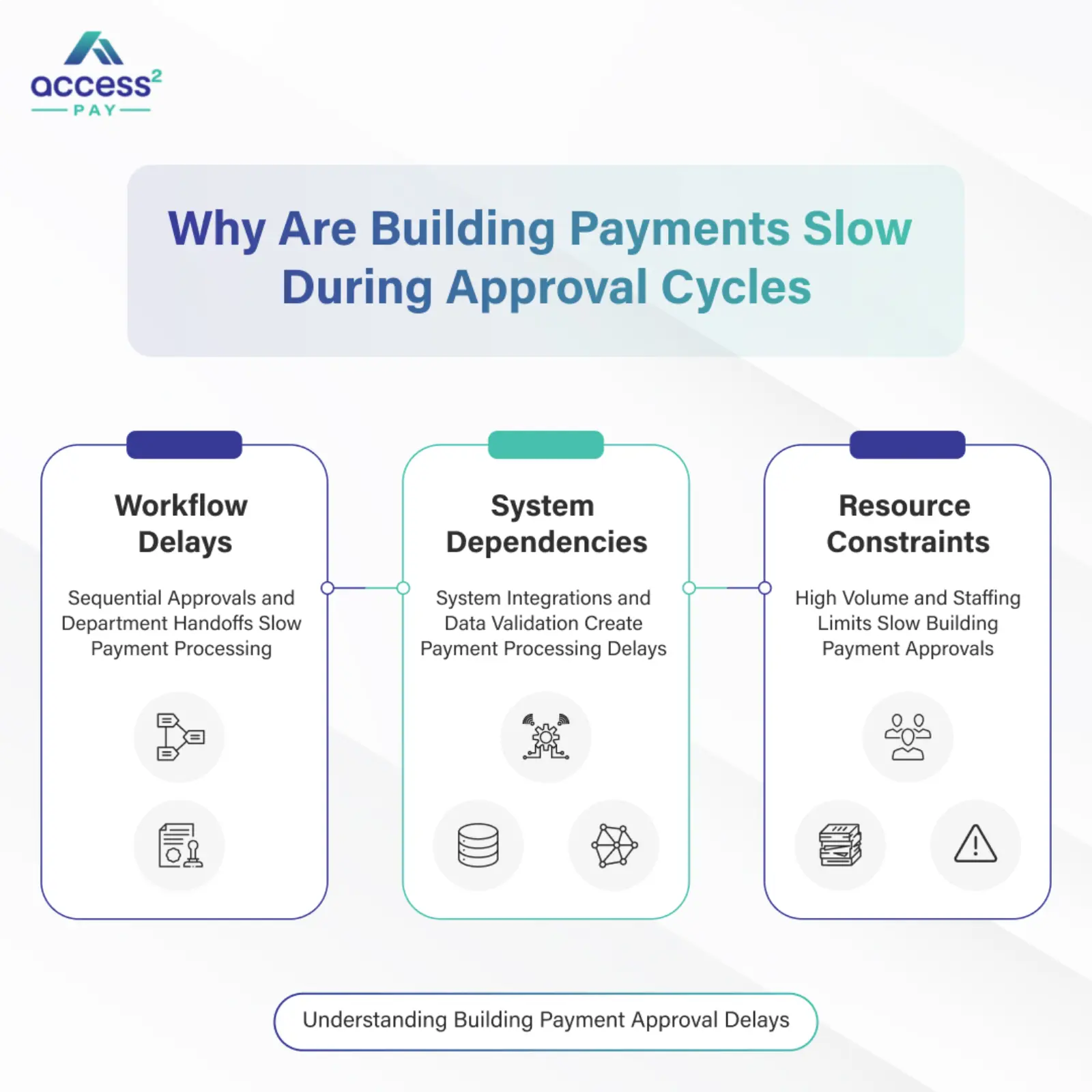
Workflow sequencing is the most common structural reason that building payments stall, because most approval processes are created as sequential chains where each step cannot begin until the previous one is fully complete. This design made sense in a paper-based environment where physical documents had to physically move between desks, but it creates unnecessary bottlenecks in a digital context where parallel processing is technically feasible. Agencies that have modernized their building and permit payment workflows through platforms like Access2Pay have eliminated many of these sequential constraints by enabling concurrent review and digital handoffs that do not require one party to finish before another can begin.
Sequential Review Bottlenecks Slowing Building Payments
Sequential review bottlenecks occur when each reviewer must fully complete their assessment of a building payment before it can advance to the next stage, even when their review is independent of every other step. A building payment that requires sign-off from three departments in sequence takes at least three times as long as it would if those departments reviewed simultaneously.
- Single-threaded approval chains: When a building payment moves from one reviewer to the next only after full sign-off, any delay, absence, or backlog at one stage holds the entire payment, regardless even if downstream reviewers are available and ready.
- No parallel review capability: Departments that could review different aspects of the same building payment concurrently are forced to wait their turn in a linear queue, adding days to each step with no operational justification for the wait.
Departmental Handoff Lags in Building Payments
Departmental handoffs introduce delays when the process of transferring a building payment file from one department to another is manual, undocumented, or dependent on individual staff to initiate the transfer at the right time.
- Manual transfer processes: When moving a building payment record between departments requires a staff member to email a file, physically transfer a folder, or enter data into a second system, each handoff introduces a lag that accumulates across the full approval cycle.
- Unclear handoff ownership: If no role is specifically responsible for confirming that a building payment has been received and opened by the next department in the chain, files can sit unacknowledged for days without any party realizing the process has stalled.
Approval Chain Length Impacting Building Payments
The length of an approval chain directly determines the minimum time a building payment will take to process, independent of any individual reviewer’s efficiency. According to Rabbet’s 2024 Construction Payments Report, 38% of general contractors cite lender-related delays and 27% cite process management issues as their top two barriers to timely building payments, both of which are driven in part by approval chains that include more steps than the transaction actually requires.
- Approval steps that add no verification value: Not every reviewer in a building payment chain adds a genuinely distinct check; some steps exist for historical reasons and no longer serve a compliance or accuracy purpose, adding time without adding protection.
- Threshold-based approval requirements: Approval chains that require escalating sign-offs based on dollar thresholds mean that large building payments automatically trigger longer chains, which is structurally appropriate but operationally problematic when those higher-level approvers are consistently unavailable.
Parallel Processing Gaps for Building Payments
Parallel processing gaps exist wherever steps that could legally and technically happen at the same time are instead sequenced, because the workflow has not been recreated to take advantage of the processing capability that modern systems make possible.
- Compliance checks that could run simultaneously: A building payment may need both a fee calculation validation and a registered business verification, but if these checks run sequentially rather than in parallel, the total processing time doubles unnecessarily.
- Notification delivery delays during parallel steps: Even when multiple reviewers are working simultaneously on a building payment, delays in system-generated notifications mean that reviewers are not alerted to their tasks promptly, effectively converting a parallel process back into a sequential one.
Status Update Delays During Building Payments Cycles
Status update delays keep all parties in the dark about where a building payment stands in the approval cycle, which leads to duplicate follow-up inquiries, manual status checks, and unproductive administrative overhead that consumes the same staff time that could be spent processing payments.
- No automated status notifications: When a building payment advances through each approval stage, automated notifications to the submitting party eliminate the need for manual follow-up calls and emails, but systems without this capability require staff to field constant status inquiries.
- Internal status visibility gaps: When departments reviewing a building payment cannot see what stage it is at in other departments, they cannot prioritize their own review based on the overall cycle status, leading to inefficient task sequencing.
Escalation Thresholds Prolonging Building Payments
Escalation thresholds are the dollar or complexity limits above which a building payment requires senior authorization. While these thresholds serve a legitimate oversight function, poorly calibrated thresholds that are set too low push routine building payments into escalation queues that were created for exceptional cases.
- Over-escalated routine building payments: When standard permit payments exceed an outdated dollar threshold, they trigger an escalation path originally created for unusual transactions, which routes them to senior staff whose schedules are not structured around routine payment approvals.
- Insufficient escalation path communication: Staff handling building payments that require escalation often lack clear guidance on which escalation route to use, causing delays while they determine the correct path or wait for informal confirmation from a supervisor.
System Dependencies Causing Building Payments Slowdowns
System dependencies are a major contributor to building payment delays when the platforms involved in processing, verifying, and recording a payment were not created to communicate with each other. Most government agencies operate a combination of legacy financial systems, newer online portals, and third-party verification services that each maintain their own data formats and update cycles, creating friction at every integration point. Agencies that consolidate building payments through a purpose-built government payment platform from Access2Pay eliminate many of these integration points by processing building payments through a single system that connects directly to the relevant municipal and provincial databases rather than passing data between disconnected applications.
Integration Failures Between Building Payments Systems
Integration failures occur when two systems involved in the building payment process cannot reliably exchange data, forcing staff to manually rekey information, verify records across multiple screens, or wait for a scheduled data sync before processing can continue.
- Point-to-point integrations that break on updates: When a building payment system relies on a direct, custom-coded connection to another platform, any update to either system can break the integration, creating unplanned processing outages that halt building payment approvals until the connection is restored.
- Data format mismatches: Building payment records formatted for one system may require manual reformatting before they can be read by the next system in the workflow, introducing both delays and data entry errors.
Database Synchronization Issues in Building Payments
Database synchronization issues arise when the systems that store building payment records update at different times or intervals, causing different parts of the organization to work from different versions of the same record simultaneously.
- Batch synchronization delays: When one building payment system syncs its records to another on a nightly or hourly batch schedule rather than in real time, reviewers working between sync cycles may approve payments based on information that has already changed.
- Conflicting record states: If a building payment record is updated in one system before the sync completes, downstream systems may hold a different payment status, creating confusion about approval state and triggering duplicate review requests.
API Response Times Affecting Building Payments
Slow API response times delay building payment processing when the verification or data lookup services the payment system depends on are slow to respond. PYMNTS Intelligence research notes that 69% of construction companies still use paper checks for payments, partly because digital systems dependent on third-party APIs frequently fail to deliver the reliability that payment operations require at scale.
- Third-party verification API latency: When a building payment requires a real-time verification call to a business registry or tax database, slow API response times from that external service directly extend the processing time for every individual payment.
- Timeout-triggered manual review queues: If an API call in a building payment workflow times out, the system typically routes the payment to a manual review queue rather than retrying automatically, converting a momentary technical delay into a multi-hour human review task.
Legacy Compatibility Problems with Building Payments
Legacy system compatibility problems occur when older financial platforms used for building payment recording or reporting cannot support the data volumes, formats, or processing speeds that modern payment workflows require.
- Character limits and field format restrictions: Legacy databases created for paper-era data entry often impose field length and format restrictions that require modern building payment records to be truncated or reformatted before they can be stored, introducing errors and delays.
- Manual workarounds for unsupported features: When a legacy system cannot support an automated step in the building payment workflow, staff create manual workarounds that are time-consuming, inconsistent, and invisible to the automated audit trail.
Data Validation Loops Delaying Building Payments
Data validation loops occur when a building payment fails an automated validation check, is returned to the submitter for correction, is resubmitted, and fails again, creating a cycle that can repeat multiple times before the payment passes all checks and advances.
- Unclear validation error messages: When a building payment fails a validation check and the error message does not clearly explain what data is incorrect or what format is required, submitters guess at corrections and resubmit inaccurate records repeatedly.
- Validation rules that are not pre-communicated: If the validation requirements for a building payment are only visible at the point of submission failure rather than being communicated upfront, submitters cannot prepare compliant records before entering the workflow.
Third-Party Verification Dependencies in Building Payments
Third-party verification dependencies delay building payments when the completion of a payment requires confirmation from an external organization, such as a utility, insurer, or provincial registry, that operates on its own schedule and is not responsive to the agency’s processing timelines.
- Verification request queues at external agencies: Building payments that require a confirmation from an external government registry or licensing body are subject to that body’s own processing backlog, which may be days longer than the internal processing time for the payment itself.
- No escalation path for delayed third-party responses: When a third-party verification has been outstanding for longer than a reasonable period, the absence of a documented escalation path means the building payment simply waits rather than being progressed through an alternative route.

Resource and Volume Factors in Building Payment Delays
Resource and volume factors create building payment delays that are invisible during normal operating periods but become severe during peak seasons, staff shortages, or high-volume submission windows. According to Mobilization Funding’s 2025 Construction Delays and Payment Timing Report, 29% of construction professionals cite slow approvals and misaligned terms as top cash-flow challenges, and 34% have taken on fewer jobs specifically to manage the financial strain of unpredictable building payment timing. These resource constraints affect not just the agencies processing payments but the contractors and developers waiting to receive them.
Peak Period Overloads on Building Payments Processing
Peak period overloads occur at predictable points in the fiscal year when a high volume of building payment submissions arrives simultaneously, such as at permit renewal periods, fiscal year-end deadlines, or the start of the construction season.
- Submission clustering at deadlines: Businesses and contractors tend to submit building payments close to deadlines, creating volume spikes that overwhelm processing queues that were sized for average daily volumes rather than peak-day loads.
- Approval queue saturation during peak periods: Reviewers who handle a manageable building payments volume on a normal day face backlogs that extend processing times from hours to days during peak periods, because headcount is not scaled to peak demand.
Staff Capacity Constraints During Building Payments Peaks
Staff capacity constraints during peak periods mean that the same reviewers handling routine building payments are simultaneously managing the backlog from the volume spike, with no additional capacity available to maintain normal processing timelines.
- Cross-trained staff gaps: When only specific staff members are authorized to approve certain building payment types, absences or leave during peak periods create complete processing blocks for those payment categories rather than a slowdown that other staff can partially absorb.
- Overtime limitations in public sector agencies: Municipal and provincial agencies often face budget-driven restrictions on overtime authorization, which limits the ability to deploy additional staff time during building payment peak periods, even when the backlog is clearly quantifiable.
Documentation Review Backlogs for Building Payments
Documentation review backlogs build when the supporting documents required for a building payment, such as contractor licenses, insurance certificates, or inspection reports, arrive separately from the payment and must be manually matched before processing can proceed.
- Asynchronous document and payment submission: When a building payment and its required documentation are submitted through different channels or at different times, staff must manually hold the payment until documents arrive and then match them before processing can begin.
- Incomplete submissions requiring follow-up: Building payments submitted without all required documents require outbound communication to the submitter, a waiting period, and a re-review when the documents arrive, adding days to each affected payment cycle.
Error Correction Cycles Extending Building Payments
Error correction cycles extend building payment processing times when mistakes in the original submission, such as incorrect fee amounts, wrong account references, or invalid property descriptions, are caught only after the payment has advanced partway through the approval chain.
- Late-stage error discovery: An error in a building payment that is caught at the final approval stage, rather than at initial submission, requires the payment to be reversed or amended after significant review work has already been completed, wasting all of that effort.
- Resubmission tracking failures: When a corrected building payment resubmission is not linked to the original submission record, reviewers may treat it as a new application and repeat steps that were already completed on the original, extending the total cycle further.
Notification System Failures Impacting Building Payments
Notification system failures mean that the people and systems responsible for advancing a building payment are not alerted when action is required, causing payments to sit idle in queues that no one is aware need attention.
- Email-based notification unreliability: Building payment approval systems that send alerts through standard email is vulnerable to spam filters, inbox volume, and recipient absence, any of which can delay a reviewer’s awareness of a pending task by hours or days.
- No fallback notification for unacknowledged alerts: When a building payment notification is sent but not acknowledged within a defined period, the absence of an automated follow-up or escalation means the payment continues to wait without any party knowing it is stalled.
Compliance Check Volumes Slowing Building Payments
Compliance check volumes add to building payment processing times when each payment requires verification against multiple regulatory requirements, tax status databases, or zoning records, and those checks cannot be automated or parallelized.
- Multiple sequential compliance lookups: A building payment that requires verification of business registration status, outstanding tax liabilities, and zoning compliance must complete each check in turn if the system cannot run them simultaneously, multiplying the time consumed by each individual lookup.
- High false-positive rates in compliance screening: Compliance checks with poorly calibrated thresholds generate large numbers of false-positive flags that require manual review, diverting staff attention from processing new building payments to investigating alerts that require no corrective action.
Frequently Asked Questions
What is the most common reason building payments are delayed in municipal agencies?
The most common reason building payments are delayed in municipal agencies is sequential workflow design, where each approval step must be fully completed before the next one can begin, even when parallel processing is technically available. This design choice, combined with departmental handoff lags and a lack of automated status notifications, means that the time a building payment spends waiting between steps often exceeds the time actually spent on active review. Agencies that address this root cause by redesigning their building payment workflows for parallel processing and automating handoffs, using platforms such as Access2Pay’s municipal payment system, typically see the largest reductions in total cycle time with the least disruption to existing compliance requirements.
How do legacy systems specifically contribute to building payments delays?
Legacy systems contribute to building payment delays through three primary mechanisms: they require manual data re-entry when records cannot be transferred automatically between systems, they impose processing constraints such as batch update schedules that prevent real-time status updates, and they generate integration breakages when adjacent modern systems are updated without backward compatibility testing. The cumulative effect is that a building payment traveling through a workflow that includes legacy system touchpoints will consistently take longer than the same payment processed entirely through a modern, integrated platform. Replacing legacy touchpoints entirely is the most effective long-term solution, but agencies can achieve meaningful improvements in the short term by identifying the specific legacy system bottlenecks that add the most time and prioritizing those for integration or replacement.
Can automation fully solve building payments approval cycle delays?
Automation can eliminate most of the delay time in a building payment approval cycle that comes from waiting for manual handoffs, sequential reviews, and status updates, but it cannot address delays that originate from genuinely required human judgment or from resource constraints at peak volumes. The most effective approach combines automation of the mechanical steps, such as fee calculation validation, document matching, and status notification, with workflow redesign that reduces the number of steps requiring human review without removing the oversight that compliance requires. Access2Pay’s government payment solutions are created with this balance in mind, automating the routine components of building payment processing while maintaining the audit trails and approval structures that regulatory compliance demands.
Modernizing Building Payments to Speed-Up Payment Cycles
Building payments slow down during approval cycles for a set of reasons that are well-documented, structurally predictable, and operationally fixable. Workflow sequencing that was created for paper-based processes, system integrations that were built for lower volumes, and resource capacity that was not sized for peak demand all compound each other, turning a transaction that should take hours into one that routinely takes weeks. The financial consequences are significant: Rabbet’s 2024 data showing $280 billion in slow-payment costs and an average payment cycle of 90 days reflects a structural problem, not an isolated operational failure, and it affects every party in the building payment chain from the agency processing the payment to the contractor waiting to receive it.
Modernizing building payments requires addressing each delay category at its source: redesigning workflows for parallel processing rather than sequential approval chains, replacing or bypassing legacy system bottlenecks, and building the notification and monitoring infrastructure that keeps every step in the approval cycle visible in real time. Access2Pay’s government payment platform gives municipal agencies and provincial governments the infrastructure to process building payments through compliant, integrated, and automated workflows that reduce cycle time without reducing the oversight that public-sector payment processing requires.

Sources
-
- IBM Security. (2024). Cost of a data breach report 2024. Cited in: Accutive Security.
https://accutivesecurity.com/data-breach-statistics-2024-penalties-and-fines-for-major-regulations/ - Rabbet. (2024). 2024 Construction Payments Report.
https://rabbet.com/reports/construction-payments-2024 - Rabbet. (2023). How slow payments are costing the construction industry billions.
https://rabbet.com/blog/how-slow-payments-are-costing-the-construction-industry-billions - PYMNTS Intelligence. (2024, January). Breaking ground: Solving construction’s delayed payments with digital tools. American Express.
https://www.americanexpress.com/content/dam/amex/us/merchant/pdf/bcfm/PYMNTS-Construction-Delayed-Payments-January-2025.pdf - PYMNTS. (2023). From the ground up: Rebuilding payments in the construction industry.
https://www.pymnts.com/tracker_posts/from-the-ground-up-rebuilding-payments-in-the-construction-industry/ - For Construction Pros. (2025). Ending payment delays in the construction industry. Fractal.
https://www.forconstructionpros.com/business/business-services/financing-insurance-leasing/article/22932492/fractal-ending-payment-delays-in-the-construction-industry - Mobilization Funding. (2025). 2025 construction delays and payment timing report.
https://mobilizationfunding.com/2025-construction-delays-payment-report/ - PBMares. (2024, November 18). Accounts receivable in construction: Cash flow at risk amid payment delays.
https://www.pbmares.com/accounts-receivable-in-construction-cash-flow-at-risk-amid-payment-delays/ - Access2Pay. (2025). Government payment solutions.
https://access2pay.com/government-payments/ - Access2Pay. (2025). Municipal government payment processing.
https://access2pay.com/government-payments/municipal-government/ - Access2Pay. (2025). Provincial and state government payment solutions.
https://access2pay.com/government-payments/provincial-and-state-government/
- IBM Security. (2024). Cost of a data breach report 2024. Cited in: Accutive Security.
