
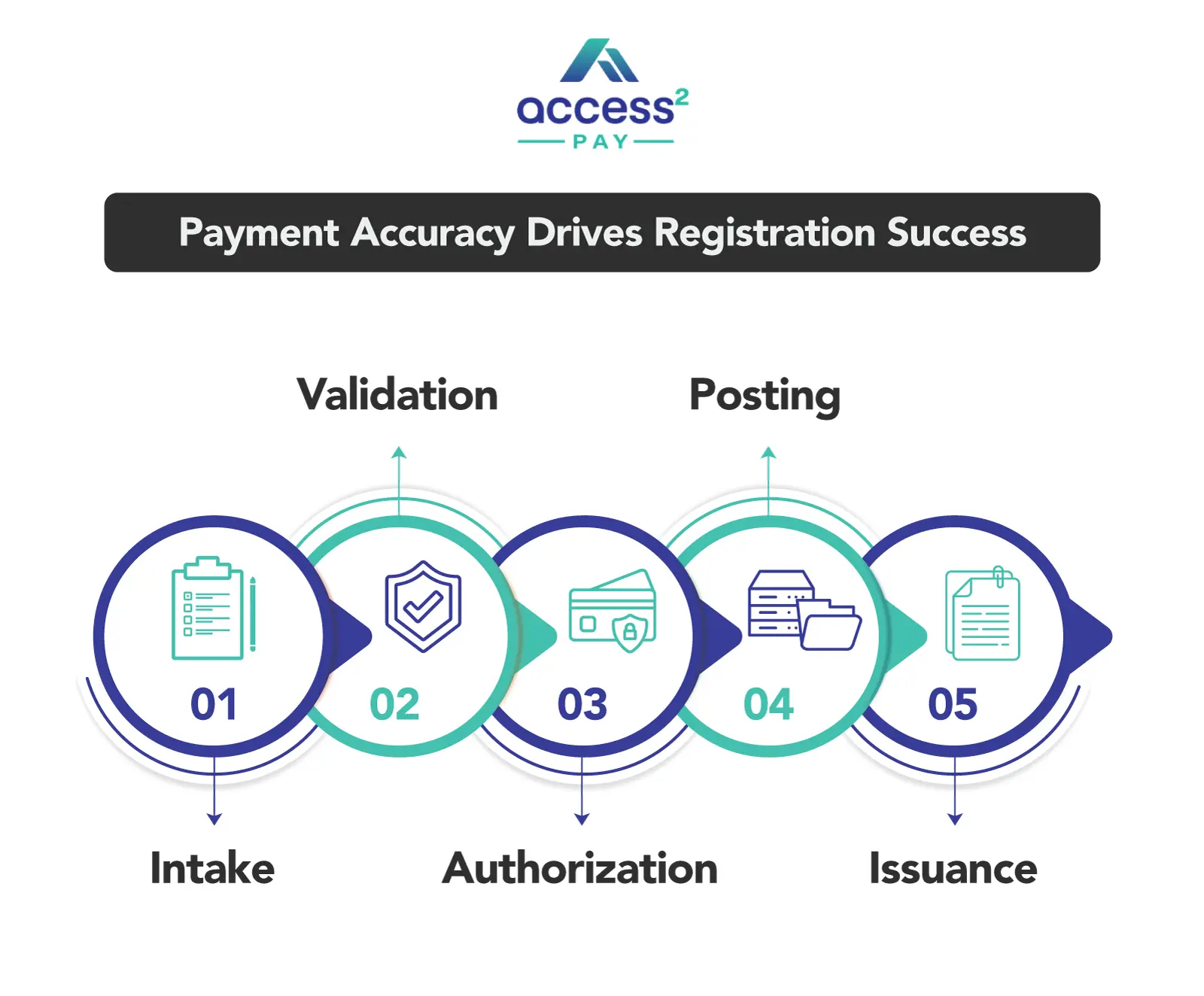
Vehicle registration payment is not a single transaction. It is a controlled sequence of intake, validation, authorization, posting, and fulfillment that must operate in lockstep across multiple systems. When that sequence holds, payments clear cleanly, records stay accurate, and enforcement actions remain fair. When it breaks, delays surface, staff intervene manually, and public confidence erodes. Understanding how vehicle registration payment works inside public systems gives agencies the leverage to reduce risk, protect revenue, and scale service without chaos.
Key Takeaways:
- Vehicle registration payment systems rely on structured handoffs between intake, validation, authorization, posting, and fulfillment, with most failures occurring during system synchronization rather than payment authorization.
- Accurate data capture, rule-based fee calculation, and real-time posting visibility reduce delays, prevent enforcement errors, and protect revenue integrity at scale.
- Governments that align payment, registration, enforcement, and reporting systems minimize manual intervention, improve public confidence, and sustain reliable operations during peak renewal cycles.
Step-by-Step Vehicle Registration Payment Workflow
Every vehicle registration payment moves through a defined operational sequence. While the steps appear straightforward, complexity concentrates in the transitions between systems. Each handoff relies on the accuracy and completeness of the previous stage. Weak structure early forces correction later, often through manual intervention that increases cost and delay.
Vehicle registration payment workflows follow a structured path from intake and validation through authorization, posting, and fulfillment, with most delays occurring during system handoffs rather than payment authorization.
Intake and Application Initiation for Vehicle Registration Payment
Intake establishes the foundation for the entire transaction. At this stage, systems capture vehicle identifiers, owner information, jurisdiction rules, registration term selections, and compliance indicators. Eligibility is determined before payment begins, which protects downstream systems from processing invalid requests.
Well-designed intake enforces accuracy by applying:
- Mandatory field completion tied to registration rules, ensuring that required identifiers and ownership details exist before the transaction advances.
- Format validation for VINs, plate numbers, and identity fields, preventing malformed data from entering authoritative systems.
- Jurisdiction-specific logic, which differentiates renewals, transfers, and new registrations without relying on manual classification.
When intake allows incomplete or inconsistent data, downstream systems compensate through manual review. That compensation becomes a primary source of delay and backlog.
Fee Calculation and Assessment in Vehicle Registration Payment
Fee calculation converts policy into executable logic. Registration fees depend on multiple variables, including vehicle class, emissions category, weight, registration duration, penalties, exemptions, and local surcharges. Each variable must align with current regulations at the moment of payment.
Accurate fee assessment depends on:
- Centralized rate tables, maintained and updated as regulations change to prevent outdated charges.
- Rules engines capable of evaluating multiple conditions simultaneously, avoiding conflicts between overlapping policies.
- Version tracking, which preserves historical accuracy when rates change mid-cycle.
Even small calculation errors trigger disputes, refunds, and reprocessing. Precision at this stage prevents cascading corrections later.
Fee calculation errors in vehicle registration payment often lead to refunds, disputes, and delayed posting, making accurate rule-based assessment critical to system stability.
Payment Gateway Interaction During Vehicle Registration Payment
Once fees calculate, the transaction routes through a secure payment gateway. This interaction validates payment method legitimacy and fund availability while shielding sensitive credentials from registration systems.
Reliable gateway interaction is characterized by:
- Tokenization, which isolates payment credentials from operational databases.
- Immediate authorization responses, allowing systems to progress without unnecessary waiting states.
- Consistent error messaging, enabling clear user feedback and predictable exception handling.
Gateways do not complete the transaction. They signal readiness. Internal systems still control posting, reconciliation, and fulfillment.
Validation and Confirmation of Vehicle Registration Payment
Validation confirms that the transaction meets financial, operational, and regulatory requirements. This step reconciles calculated fees, authorization responses, and current registration eligibility.
Validation logic typically verifies:
- Alignment between the authorized amount and the assessed fee, preventing underpayment or overpayment acceptance.
- Unchanged eligibility status, ensuring no enforcement or compliance condition emerged mid-transaction.
- Transaction uniqueness, blocking duplicate submissions from retry behavior or system latency.
Confirmation marks the transition from a payment attempt to a payable transaction.
Posting and Updating Records After Vehicle Registration Payment
Posting commits the transaction to authoritative records. Financial ledgers update, registration status changes, and enforcement systems receive new data. From an operational perspective, posting defines completion.
Posting delays commonly occur when:
- Systems depend on batch processing schedules, postponing updates until predefined windows.
- Reconciliation precedes posting, delaying status updates until settlement verification completes.
- Cross-system synchronization lags, leaving one platform updated while others wait.
From the registrant’s perspective, posting defines success. Delayed posting creates confusion even when funds have cleared correctly.
Vehicle registration payment posting delays usually stem from batch processing or system synchronization gaps rather than failed transactions.
License Plate and Document Issuance Tied to Vehicle Registration Payment
Fulfillment begins only after posting confirms success. Systems trigger document generation, plate validation, mailing workflows, and digital proof issuance. Each action depends on synchronized data across issuing platforms.
Issuance relies on:
- Confirmed posting status, ensuring funds are officially recorded.
- Complete and accurate registration data, preventing document rework.
- Successful synchronization across issuing systems, allowing automated fulfillment to proceed.
Any inconsistency halts issuance and escalates the transaction into manual handling queues.
Securing Accuracy and Consistency in Vehicle Registration Payment
Accuracy compounds over volume. Small inconsistencies become material issues when multiplied across thousands of transactions. Effective systems prevent drift continuously rather than correcting it after posting.
Accuracy in vehicle registration payment systems depends on continuous validation, reconciliation, and synchronization rather than post-transaction correction.
Data Quality Controls in Vehicle Registration Payment
Data quality controls operate at every system entry point. They enforce structure, logic, and alignment with reference data before transactions progress.
Effective controls address:
- Field-level validation, confirming required formats and value ranges.
- Cross-field dependency checks, ensuring related inputs remain consistent.
- Reference table alignment, matching submissions against authoritative datasets.
Preventing bad data early costs far less than correcting it after posting.
Matching Payment Records to Vehicle Registration Profiles
Every transaction must anchor to a single registration profile. Matching failures result in misapplied payments, incorrect enforcement actions, and reconciliation delays.
Robust matching relies on:
- Unique transaction identifiers, preventing ambiguity across systems.
- Immutable registration reference keys, preserving historical continuity.
- Rejection of ambiguous matches, forcing resolution before posting.
Clear linkage protects both revenue integrity and registrant trust.
Handling Adjustments and Corrections in Vehicle Registration Payment
Adjustments arise from exemptions, ownership changes, valuation corrections, or overpayments. Systems must process changes without erasing transactional history.
Structured adjustment handling promises:
- Original transactions remain intact, preserving audit continuity.
- Adjustments remain traceable and reversible, supporting accountability.
- Financial totals remain balanced, preventing ledger distortion.
Unstructured corrections weaken audit confidence and slow resolution.
Reconciliation Between Bank and System Records for Vehicle Registration Payment
Reconciliation verifies that posted transactions match settled funds. Automated routines surface discrepancies before they become reporting issues.
Strong reconciliation processes:
- Compare settlement files against internal ledgers, confirming completeness.
- Separate timing differences from failures, preventing false alarms.
- Maintain owned exception queues, ensuring accountability for resolution.
Delayed reconciliation hides exposure and complicates audits.
Audit Trails and Reporting for Vehicle Registration Payment Activity
Audit trails capture every system and user action tied to a transaction. Reporting tools convert those logs into operational and oversight visibility.
A strong audit posture includes:
- Immutable logs, protected from alteration.
- Time-stamped actions, supporting chronological reconstruction.
- Role-based visibility, clarifying responsibility and access.
Audits should confirm controls, not reconstruct events.
Coordination Between Enforcement and Vehicle Registration Payment Systems
Enforcement outcomes depend on accurate, timely payment status. Delayed updates trigger unnecessary citations, appeals, and administrative workload.
Tight coordination guarantees:
- Immediate propagation of payment status, preventing enforcement errors.
- A shared source of truth, reducing cross-team disputes.
- Lower appeal volumes, saving staff time and public frustration.
Alignment protects fairness, revenue, and institutional credibility.

Streamlining Vehicle Registration Payment
Streamlining vehicle registration payment is about protecting flow across systems rather than chasing raw speed. Payments move smoothly when intake, validation, posting, and fulfillment operate as a single chain. When that chain fractures, delays appear even in well-funded environments. Governments that streamline effectively focus on predictability, visibility, and controlled escalation rather than isolated optimizations.
Designing for Volume Without Failure
Vehicle registration cycles generate predictable transaction spikes tied to renewal periods, policy changes, and enforcement deadlines. Systems must absorb these surges without degrading response times or compromising accuracy. Volume pressure exposes weak architecture faster than any audit.
Scalable system design relies on:
- Elastic infrastructure, which expands processing capacity automatically during peak renewal windows and contracts afterward to control costs.
- Load-aware processing, which distributes transactions evenly across services to prevent localized bottlenecks from stalling the entire workflow.
- Prioritized transaction queues, which help critical actions such as posting and enforcement updates complete before lower-impact background tasks.
When volume resilience is built into the platform, accuracy remains stable regardless of demand.
Reducing Public Confusion Through Status Transparency
Most public frustration stems from uncertainty rather than failure. When registrants cannot see where their payment sits in the process, they assume something went wrong. Clear status transparency replaces guesswork with certainty.
Effective status visibility communicates:
- Received, confirming the system has captured the transaction request.
- Authorized, showing the payment method has been approved.
- Posted, indicating the transaction is recorded in official financial and registration systems.
- Issued, confirming documents or plates are released.
Clear status markers reduce inbound calls, limit disputes, and allow staff to focus on resolution rather than reassurance.
Managing Exceptions Without Manual Overload
Exceptions will always exist. What separates resilient systems from fragile ones is how those exceptions are contained. Unstructured exception handling spreads delays across unrelated transactions and overwhelms staff.
Structured exception management depends on:
- Categorized queues, which separate data issues, payment failures, compliance flags, and system errors, instead of mixing them together.
- Automated routing, which sends each exception to the correct team with predefined response paths.
- Full transaction context, allowing staff to see payment history, validation results, and system interactions without switching tools.
When exceptions stay contained, routine transactions continue uninterrupted.
Synchronizing Payment Flow Across Departments
Vehicle registration payment touches finance, enforcement, licensing, and customer service teams. Streamlining fails when each department optimizes independently. Cross-department synchronization helps that payment status changes propagate instantly wherever they matter.
Effective synchronization secures:
- Financial posting updates enforcement eligibility without delay
- Licensing systems reflect payment status before document issuance
- Support teams see the same status as the registrant
Shared visibility prevents contradictory actions and reduces internal escalations.
Reducing Rework Through Proactive Monitoring
Rework consumes more resources than prevention. Streamlined environments detect stress signals early and intervene before queues grow. Monitoring shifts operations from reactive cleanup to controlled adjustment.
Proactive monitoring focuses on:
- Transaction dwell time at each stage of the workflow
- Growth in pending or exception queues
- Repeated failures tied to specific payment methods or data fields
Early intervention keeps small issues from turning into systemic backlogs.
FAQ
How long does vehicle registration payment take to reflect in the system?
Authorization occurs immediately after submission. Posting follows once the settlement is confirmed. Timing varies by payment method and processing windows. Monitoring tools help teams track pending status accurately.
Why does enforcement sometimes show unpaid after payment?
Enforcement systems update based on posted status rather than authorization. Delays occur when synchronization runs on schedules. Real-time integration reduces this gap.
Can installment plans work for vehicle registration payment?
Installments require precise tracking across periods. Systems must reflect partial balances without ambiguity. Automated reminders and synchronized ledgers reduce mismatch risk.
Keeping Vehicle Registration Payment Reliable at Scale
Vehicle registration payment reliability depends on disciplined sequencing, continuous validation, and shared visibility. When systems align, payments post cleanly, enforcement remains fair, and public confidence holds. Agencies that invest in structure reduce manual intervention and scale without instability. As transaction volumes rise, reliability becomes the true measure of system maturity.