
Payment confirmation in the Canadian government marks the point where a payment is formally recorded as processed, but the work does not stop there. What follows involves settlement cycles, system updates, bank clearing, and reconciliation steps that connect the government’s internal records to the payee’s account. For departments, suppliers, and benefit recipients alike, understanding what comes after payment confirmation helps everyone track obligations accurately and respond to discrepancies quickly.
What Payment Confirmation Means in Government
Payment confirmation in a government system is the official record that a specific transaction has been processed. It appears as a status update in internal finance systems, a portal notification, or a bank-issued acknowledgment. Departments across CRA, PSPC, and ESDC each use their own platforms, but the meaning is consistent: confirmation signals the payment has cleared internal approval and is moving toward the payee.
Confirmation vs Authorization
Authorization and confirmation are two different points in the government payment workflow. Authorization is the internal approval that budget funds can be committed to a specific obligation. Confirmation records that the payment was actually processed and issued through the payment system.
In many departments, authorization happens days before confirmation, depending on payment run schedules. Payees and auditors need to understand this distinction because the two dates are not the same and serve different purposes in financial reporting.
What Confirmation Actually Records
When a payment is confirmed, the system records the payment amount, the payee identifier, the confirmation date, and the transaction reference number. In an enterprise resource planning system, the status changes from “pending” or “approved” to “confirmed” or “paid.”
That status change updates accounts payable, payroll, or benefit modules depending on the payment type. Every downstream report and dashboard then reflects the updated financial position automatically.
Legal Weight of a Confirmation
Payment confirmation carries direct legal significance in government financial management. It serves as evidence that a legal obligation has been discharged on a specific date.
For year-end reporting, confirmed payments are recorded as expenses within the fiscal period. For late payment interest calculations and dispute resolution timelines, the confirmation date is often the reference point used by both the department and the payee.
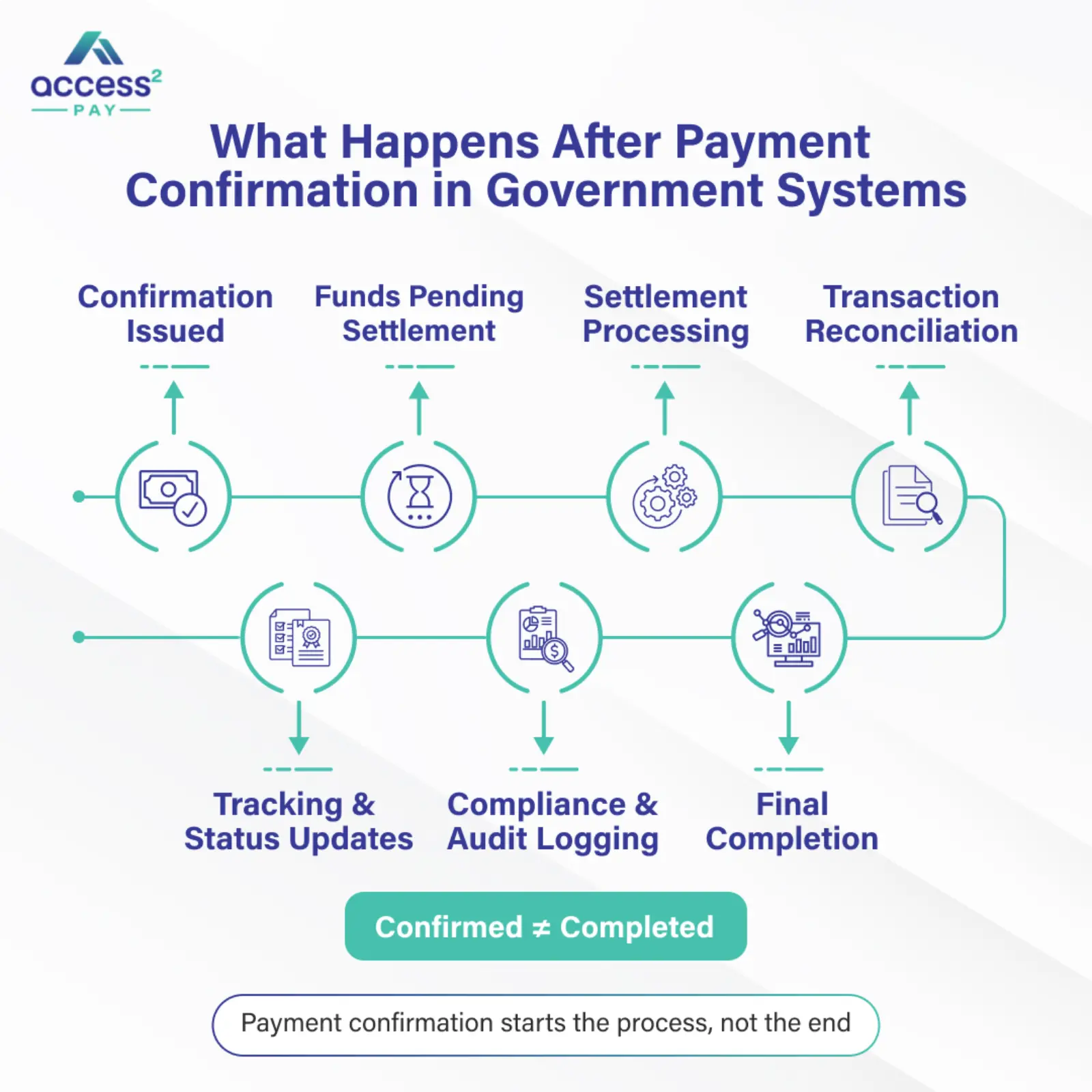
What Happens Immediately After Payment Confirmation
ERP and System Status Updates
Government ERP systems update transaction status the moment confirmation is recorded. The payment moves from “pending” or “approved” to “confirmed” or “paid” across accounts payable, payroll, or benefit modules.
Budget encumbrances are released, purchase orders may close automatically, and financial dashboards are refreshed. The transaction reference number generated at this point becomes the key identifier for all future tracking, reconciliation, and audit queries.
Workflow Triggers and Notifications
Many Canadian government payment systems use automated workflow rules that respond directly to confirmation events. A confirmed vendor invoice may close the linked purchase order and notify the contract manager.
A confirmed payroll run may trigger generation of pay stubs and tax slip data. Requestors typically receive a system notification or email alert. Payees may receive an email, a text message, or a portal status update depending on the department and payment type.
How Funds Are Settled After Confirmation
Settlement is the process by which funds actually move from the government account to the payee account. It is a separate and subsequent step from payment confirmation. The timing depends on the clearing network used, the payment method, and when the confirmation was recorded before or after the bank’s daily cut-off time.
Clearing Networks and Settlement Timing
The Government of Canada routes payments through two primary clearing systems. The Automated Clearing Settlement System (ACSS) handles the majority of direct deposit and EFT payments in overnight batch cycles.
Lynx handles large-value and time-sensitive wire payments immediately throughout the business day. According to Payments Canada’s 2024 Annual Report, Canada’s payment systems processed $107 trillion in 2024, averaging more than $424 billion every business day. Government disbursements represent a significant share of that daily volume.
Bank Cut-Off Times
Government-servicing banks apply daily cut-off times for same-day and next-day processing. A payment confirmed after the cut-off is included in the following business day batch.
This creates the gap that most payees experience between seeing a confirmed status in a portal and actually receiving funds. Departments that manage high-volume benefit runs build this timing into their processing schedules and communicate expected receipt dates to payees to reduce status inquiries.
Reconciliation After Settlement
Once funds are settled, finance teams reconcile confirmation records against bank statements. Discrepancies between confirmed payments and settled amounts are flagged and investigated before the next reporting cycle.
According to Payments Canada’s 2025 Canadian Payment Methods and Trends Report, Canada reached $12.2 trillion in payment transactions in 2024 with 22.5 billion individual transactions processed. Automated reconciliation tools that match records without manual review are the only practical way to manage discrepancy detection at that volume.

How Government Agencies Track Confirmed Payments
Government agencies track confirmed payments through payment registers, ERP transaction logs, and reconciliation workflows. Each confirmed payment is assigned a unique transaction reference that links the internal record to the bank settlement record. Finance teams use these references to locate, verify, and report on any transaction throughout its lifecycle.
Payment Registers
Payment registers record every transaction against its confirmation reference, date, amount, and payee. Finance staff reconciles these registers against bank payment advice files after each settlement cycle.
Discrepancies are flagged before the next reporting period, which is how processing errors and settlement failures are caught before they affect financial statements. Departments running high payment volumes perform this reconciliation daily or weekly rather than waiting for the month-end.
Cross-Department Tracking
Some payments involve multiple departments or flow through the Receiver General on behalf of a department. The Receiver General processes direct deposit, EDI, wire, and cheque payments for federal departments and Crown corporations.
The Government of Canada Domestic Payments open dataset publishes monthly transaction volumes and dollar values by department and payment type. This transparency layer supports internal management and public accountability simultaneously.
When a Payment Is Considered Fully Completed
A payment is considered fully completed in a government system when it has been confirmed, settled, and reconciled. All three stages must close before the transaction is removed from outstanding obligations. For payees, completion means funds are in their account, and a remittance record exists to match against their own records.
For departments, completion means the payment is recorded as an expense in the correct fiscal period. Payments confirmed within the fiscal year but not settled until after March 31 require careful classification in financial statements. Finance teams must track these transitions accurately to avoid misrepresenting departmental spending in public accounts, which can affect the department’s audit opinion if the amounts are material.
Common Issues After Payment Confirmation
Most post-confirmation issues in government payment systems are predictable and preventable. They arise from timing mismatches, data errors, or integration gaps between systems. Recognizing these patterns helps departments and payees respond quickly rather than waiting for the issue to surface through a formal inquiry process.
- Confirmation without settlement: A payment confirmed internally can fail to settle at the bank level if the file was submitted after cut-off or contained incorrect payee account details.
- Delayed status updates: Batch-processed payments may display as “pending” in portals until an overnight system update runs, even if the payment file has already been transmitted to the bank.
- Duplicate confirmations: System errors or manual resubmissions after a perceived failure can generate two confirmation records for the same transaction, requiring a reversal and reconciliation correction.
- Incorrect payee details: A confirmed payment routed to an outdated account number may settle without triggering a system error, requiring a recall and reissue process.
- Stale authorizations: Payments authorized long before confirmation should be reviewed for ongoing validity before processing, particularly if the underlying contract or entitlement has changed.
- Integration failures: Gaps between ERP, payroll, and banking systems can leave payment registers and confirmation records out of sync after settlement.
How Payment Confirmation Supports Compliance and Audits
Payment confirmation records are the foundation of financial compliance in government systems. They provide auditors with the evidence trail needed to verify that payments were authorized before they were made and that amounts match the underlying obligations. Without accurate confirmation records, departments cannot demonstrate that their financial controls functioned correctly.
Segregation of Duties Testing
Internal auditors use payment confirmation records to verify segregation of duties. They confirm that the individual who authorized a payment was different from the individual who confirmed it. This is a basic control requirement under Treasury Board financial management policy.
Any instance where authorization and confirmation share the same user account or timestamp is flagged as a control deficiency, regardless of if the underlying payment was correct.
Year-End Financial Reporting
Government payment system confirmation records are the source data for departmental financial statements. All payments confirmed within the fiscal year are recorded as expenses for that period. Payments authorized but not confirmed before March 31 remain as outstanding obligations.
This classification is audited annually, and errors in confirmation timestamping can result in misstatement findings that affect the department’s overall audit opinion.
Why Payment Status May Still Change After Confirmation
A confirmed payment does not always remain in that status permanently. Several circumstances cause a confirmed payment to be reversed, returned, or adjusted after the confirmation record is created. Both departments and payees need to understand these scenarios to respond without unnecessary delay.
Reversals
A reversal cancels a confirmed payment before or after settlement. Common causes include incorrect payee details, duplicate submissions, or an entitlement change identified after the payment was already confirmed. If the payment has settled, the department must initiate a recall through its banking partner.
The original confirmation record is not deleted; a corresponding reversal entry is added against the same reference number, so the full transaction history remains intact.
Returned Payments
Returned payments occur when funds are sent but cannot be deposited into the payee’s account. Typical causes include a closed account, changed banking details, or an undeliverable cheque. The funds return to the government account, and the payment status changes to returned.
Finance teams must reissue the payment with corrected details. Payees who expected a payment and received nothing should contact the issuing department immediately with their payment reference to trigger the reissue process.
Post-Confirmation Adjustments
Adjustments after confirmation arise when the underlying entitlement or contract amount changes after the payment has already been processed. The original confirmed payment stands as the record for the amount issued.
The adjustment appears as a separate transaction, either an additional payment or a recovery, linked to the original by reference number. This structure keeps the full payment history traceable during any future audit without requiring modification of the original confirmation record.
Best Practices for Managing Payment Confirmation in Government
Effective management of payment confirmation in government starts with consistent practices around recording, tracking, and reconciliation. Departments that apply these practices experience fewer discrepancies, faster resolution, and cleaner audit results across every payment type they manage.
- Unique reference numbers: Assign a unique confirmation reference to every payment so that records from internal systems and the bank can be matched quickly at reconciliation.
- Timely reconciliation: Match confirmation records against bank settlement data within one to two business days of each processing cycle to prevent errors from compounding.
- Segregation of duties: Ensure the individual who authorizes a payment is different from the individual who confirms it, which is a required control in government financial management.
- Automated exception flags: Use system rules to flag unmatched confirmations, duplicates, and stale authorizations automatically rather than relying on manual review to find them.
- Proactive payee communication: Notify payees when confirmation status changes and when to expect settlement, which reduces inquiry volume significantly during high-volume payment runs.
- Documented escalation paths: Define who is responsible for investigating confirmation discrepancies, within what timeframe, and through what steps when an issue is identified.
Improving Visibility After Payment Confirmation
Visibility into post-confirmation payment status is a persistent challenge in departments managing large transaction volumes. When finance teams, requestors, and payees cannot see the same status information immediately, the number of manual inquiries increases, and errors take longer to detect. Improving visibility addresses both problems simultaneously.
Centralizing Confirmation Data
Departments that consolidate confirmation data from multiple systems into a searchable central tracker resolve inquiries faster. When accounts payable, payroll, and benefits confirmation records are accessible from one interface, any transaction can be located by reference number without navigating multiple separate platforms.
This consolidation does not require replacing existing systems. Reporting layers or middleware that pull status data from each source into a unified view achieve the same result with less disruption.
Self-Service Payee Access
Self-service portals that display payment confirmation and settlement status directly to payees reduce inquiry volume significantly. CRA’s My Account and departmental supplier portals already provide this for many payment types. Departments that extend this capability to additional payment categories give payees access to the records they need without requiring manual retrieval from finance staff.
When a payee can see their own confirmation status, expected settlement date, and payment history in one place, most common questions are answered before they become a formal inquiry.
Immediate Integration Between Systems
Departments that integrate their internal confirmation records with bank settlement data immediately can identify discrepancies automatically rather than discovering them during a scheduled review cycle. Automated matching tools flag unreconciled confirmations the same day they occur, which shortens the time between a payment issue arising and its detection.
For high-volume programs that cannot afford delays between settlement and reporting, on-time integration between confirmation and bank data is the clearest path to both operational efficiency and audit readiness.
Payment Confirmation Starts the Process – Not the End
Understanding what comes after payment confirmation helps departments manage their financial obligations accurately and helps payees know what to expect after receiving a confirmation notification. The seven stages that follow, from funds pending through settlement, reconciliation, tracking, compliance logging, and final completion, each depend on the accuracy of the confirmation record that triggered them. Access2Pay supports government departments in managing every stage of this post-confirmation workflow with the tools and visibility needed to maintain accurate records, respond to inquiries quickly, and stay ready for audit at all times.