Property tax payment status sits at the centre of trust between governments and property owners. When a payment clears a bank account yet still appears unpaid in a portal, confidence drops fast. Calls increase. Disputes follow. Staff scramble to reconcile records that should already align. You see the pattern across municipalities, regional authorities, and shared service agencies.
Property tax payment status delays rarely stem from a single failure. They grow from handoffs, timing gaps, system constraints, and human intervention layered across the payment lifecycle. When visibility breaks at any point, the public feels it immediately.
This guide explains why property tax payment status delays occur, how technical and operational factors interact, and what governments can do to reduce friction while preserving accuracy and control.
Key Takeaways
- Property tax payment status delays usually result from timing gaps across systems rather than missing payments
- Manual processes and legacy infrastructure extend delays during peak collection periods
- Clear integration and monitoring practices reduce disputes and improve public confidence
Primary Causes of Property Tax Payment Status Delays
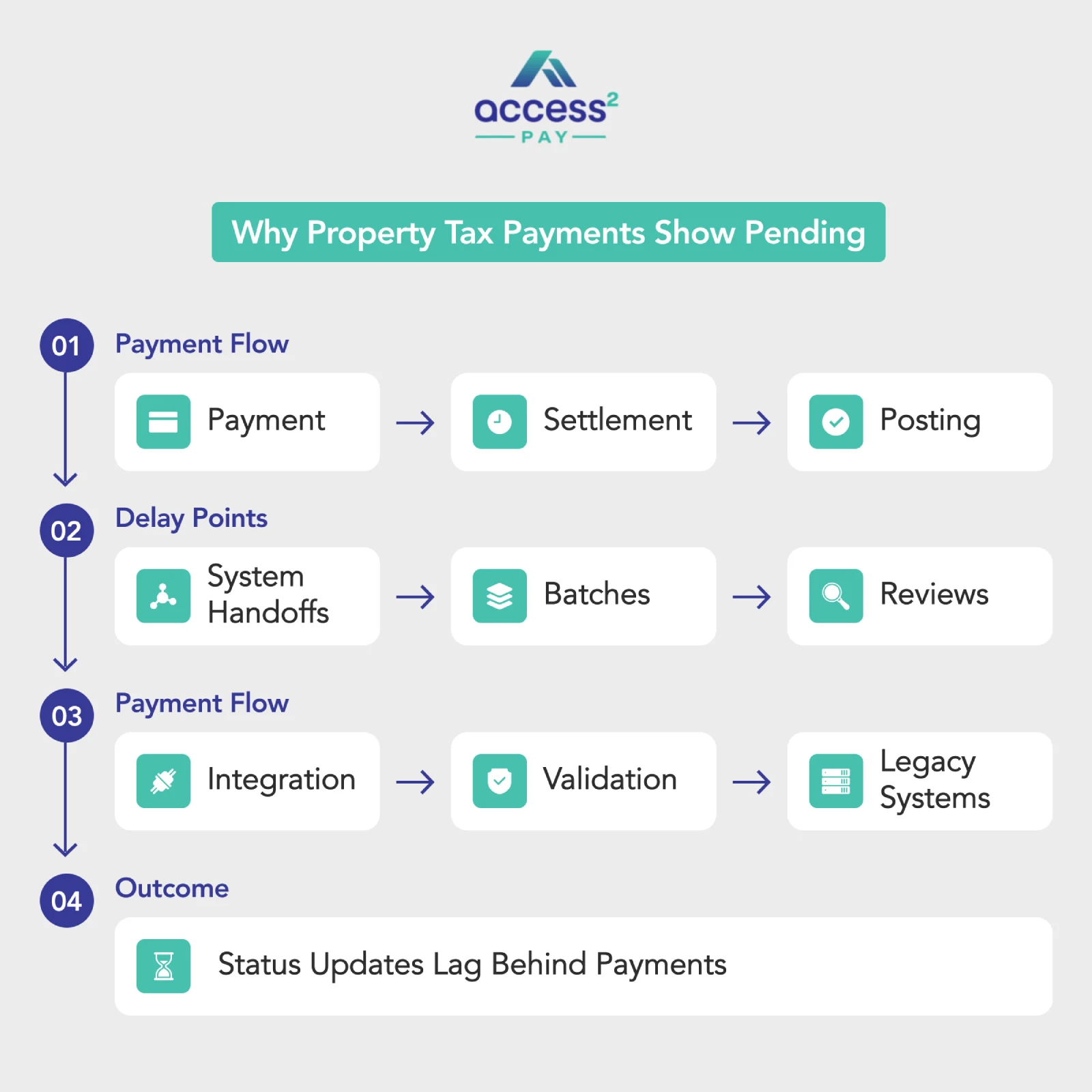
Property tax payment status updates rely on a tightly sequenced process. Authorization confirms intent to pay. Settlement confirms funds movement. Ledger posting records the transaction. Account synchronization updates the tax record. Each step must be completed in order before the public sees a status change.
When one step slows, the entire sequence pauses. This delay rarely signals a missing payment. It reflects safeguards working as designed to protect public funds. In government environments, accuracy outweighs speed. Shared services, third-party processors, audit controls, and regulatory requirements add layers that private payment systems rarely face.
These safeguards matter. Without coordination across systems, they extend timelines and reduce visibility. Understanding where delays originate allows agencies to improve communication without weakening financial controls.
System Handoffs Impacting Property Tax Payment Status Updates
Every property tax payment passes through multiple systems before reaching a completed state. A payer submits funds through an online portal or financial institution. A payment processor confirms authorization. Settlement occurs after authorization. Financial systems record the transaction. Tax systems update the account balance.
Each system operates on its own schedule and logic. When systems lack real-time communication, delays appear between handoffs. A payment may clear instantly from the payer’s perspective while internal systems wait for settlement confirmation.
Property tax payment status remains unchanged until the final handoff completes. This protects against posting funds that later fail settlement. Without clear messaging, property owners interpret this delay as an error rather than a timing safeguard.
Posting Timelines in Property Tax Payment Status Processing
Posting timelines vary by payment method and institutional rules. Credit payments authorize quickly, though settlement finalizes later. Bank transfers follow multi-day settlement windows governed by financial networks. Pre-authorized debit follows scheduled batch cycles agreed upon in advance.
Property tax payment status reflects posted funds rather than initiated payments. This rule prevents accounts from showing paid balances before funds arrive. It also creates confusion when portals fail to explain the difference between authorization and posting.
Clear communication around posting timelines reduces disputes and inbound calls. Without it, property owners assume payment failed even when funds remain in transit.
Record Synchronization Issues Across Property Tax Payment Status Platforms
Property tax systems often operate separately from core finance platforms. Updates move through scheduled synchronization jobs rather than continuous data exchange. These jobs may run hourly, nightly, or during defined windows.
When synchronization fails or runs late, systems fall out of alignment. Finance records show payment, while tax records remain unpaid. Staff receive conflicting reports across dashboards and spreadsheets.
Property tax payment status stays outdated until reconciliation is completed. These discrepancies surface during audits, account disputes, and enforcement reviews. Consistent synchronization remains a frequent challenge in multi-system environments.
Batch Processing Delays for Property Tax Payment Status
Batch processing supports financial control and audit integrity. Transactions collect in queues, then post together during scheduled runs. This approach reduces risk and simplifies reconciliation.
Batch schedules delay property tax payment status updates even after funds settle. During high-volume periods, batches grow larger and take longer to process. Queues extend further into the day or week.
Status updates lag behind actual payment activity. Without a clear public explanation, these delays appear arbitrary despite serving financial accuracy.
Manual Interventions Slowing Property Tax Payment Status
Manual review protects the system when exceptions occur. Incorrect account numbers, partial payments, ownership changes, adjustments, and refunds trigger human verification.
Manual steps pause automated workflows. Property tax payment status remains unchanged until staff resolve the exception. During peak periods, review queues grow quickly.
These interventions prevent misapplied payments and future disputes. They also introduce delays that affect multiple accounts when staffing capacity reaches limits.
Peak Season Overloads Affecting Property Tax Payment Status
Tax deadlines create predictable surges in payment volume and inquiries. Systems process higher transaction loads. Staff handle increased calls and emails. Processing windows stretch under demand.
Even well-designed platforms feel pressure during peak cycles. System throughput slows. Batch queues expand. Manual reviews increase.
Property tax payment status updates are slow as systems prioritize settlement accuracy and ledger integrity over speed. Clear communication during peak seasons reduces frustration and protects trust.
Technical Factors Behind Property Tax Payment Status Delays
Operational causes often trace back to technical limitations. Systems built years apart struggle to exchange data efficiently. Infrastructure decisions made for stability reduce speed during modern demand cycles.
Understanding these technical factors helps governments address delays without sacrificing compliance.
Integration Gaps Between Property Tax Payment Status Systems
Integration gaps appear when payment platforms and tax systems rely on file transfers rather than direct communication. Data moves in chunks rather than streams.
These gaps delay property tax payment status updates until scheduled exchanges occur. Real-time status remains unavailable despite payment completion.
Database Latency in Updating Property Tax Payment Status
High transaction volume strains databases. Indexing delays slow updates. Locking mechanisms pause writes to maintain consistency.
Database latency means payments post correctly, while status fields update later. Property tax payment status lags behind the financial truth.
API Synchronization Failures for Property Tax Payment Status
Modern platforms rely on APIs to exchange data. When APIs fail silently, updates stall without alerts.
A single failed call prevents the property tax payment status from updating across systems. Without monitoring, staff discover failures only after complaints rise.
Legacy Software Limitations on Property Tax Payment Status
Older systems prioritize stability over speed. They lack event-driven updates and rely on scheduled jobs.
Legacy platforms delay property tax payment status until background processes are complete. Modern portals surface these delays immediately to users.
Data Validation Bottlenecks in Property Tax Payment Status
Validation protects accuracy. Mismatched parcel numbers, ownership changes, and boundary updates require checks before posting.
Validation queues slow property tax payment status updates while systems confirm correctness. This step prevents misapplied payments yet extends timelines.
Network and Infrastructure Downtime Delaying Property Tax Payment Status
Infrastructure disruptions interrupt processing. Even short outages pause queues.
Property tax payment status remains unchanged until systems resume and backlogs clear. Public perception often exaggerates outage impact when communication lacks clarity.

FAQ
Why does my property tax payment show as unpaid after funds leave my account?
Funds may be authorized immediately while settlement and posting occur later. Property tax payment status updates after settlement confirmation rather than authorization. This timing gap exists to protect financial accuracy and prevent misapplied payments.
Do payment method choices affect property tax payment status timing?
Yes. Credit payments post faster than bank transfers. Pre-authorized debit follows scheduled processing windows. Each method follows different settlement rules that influence when status updates appear.
Can governments show pending payment status to reduce confusion?
Yes. Portals that display pending states reduce inquiries and improve transparency without compromising accuracy. Clear messaging helps property owners understand that processing remains underway.
Resolving and Preventing Property Tax Payment Status Delays
Eliminating delays requires coordination across finance, IT, customer service, and external vendors. Speed alone does not solve the problem. Visibility, communication, and system alignment matter more.
Governments that reduce property tax payment status delays focus on shared data models, clearer messaging, and monitored integrations. Payment events trigger updates rather than waiting for batch cycles. Portals explain timelines clearly. Staff access unified views across systems.
Preventive strategies include real-time confirmation indicators, proactive alerts for synchronization failures, and dashboards that surface backlog risks early. These measures reduce call volume, protect public trust, and preserve financial integrity.
Building Confidence Through Accurate Payment Status
Property tax payment status delays frustrate property owners and strain internal teams. These delays rarely signal missing funds. They reflect timing gaps, system constraints, and processing safeguards working behind the scenes. When governments align systems, clarify timelines, and monitor handoffs, property tax payment status becomes predictable and trustworthy. That consistency strengthens public confidence and reduces operational strain at every level.