Property tax online payment systems face maximum stress during deadline-driven surges. Volume increases sharply, user behavior shifts, and system dependencies become visible all at once. Even platforms that perform reliably throughout the year can struggle when thousands of taxpayers submit payments within narrow time windows. These failures rarely come from missing funds. They emerge from capacity limits, timing gaps, and coordination breakdowns that compound under pressure. Understanding these failure patterns allows governments to stabilize revenue collection, reduce disputes, and maintain public confidence during peak demand.
Key Takeaways
- Peak demand concentrates traffic, errors, and system dependencies, exposing weaknesses in the property tax online payment infrastructure that remain hidden during normal volume.
- Most failures stem from posting delays, gateway congestion, and synchronization gaps rather than unsuccessful payments.
- Governments that plan for surge conditions reduce penalty disputes, lower support volume, and protect predictable cash flow.
Common Failure Points in Property Tax Online Payment During Peak Demand
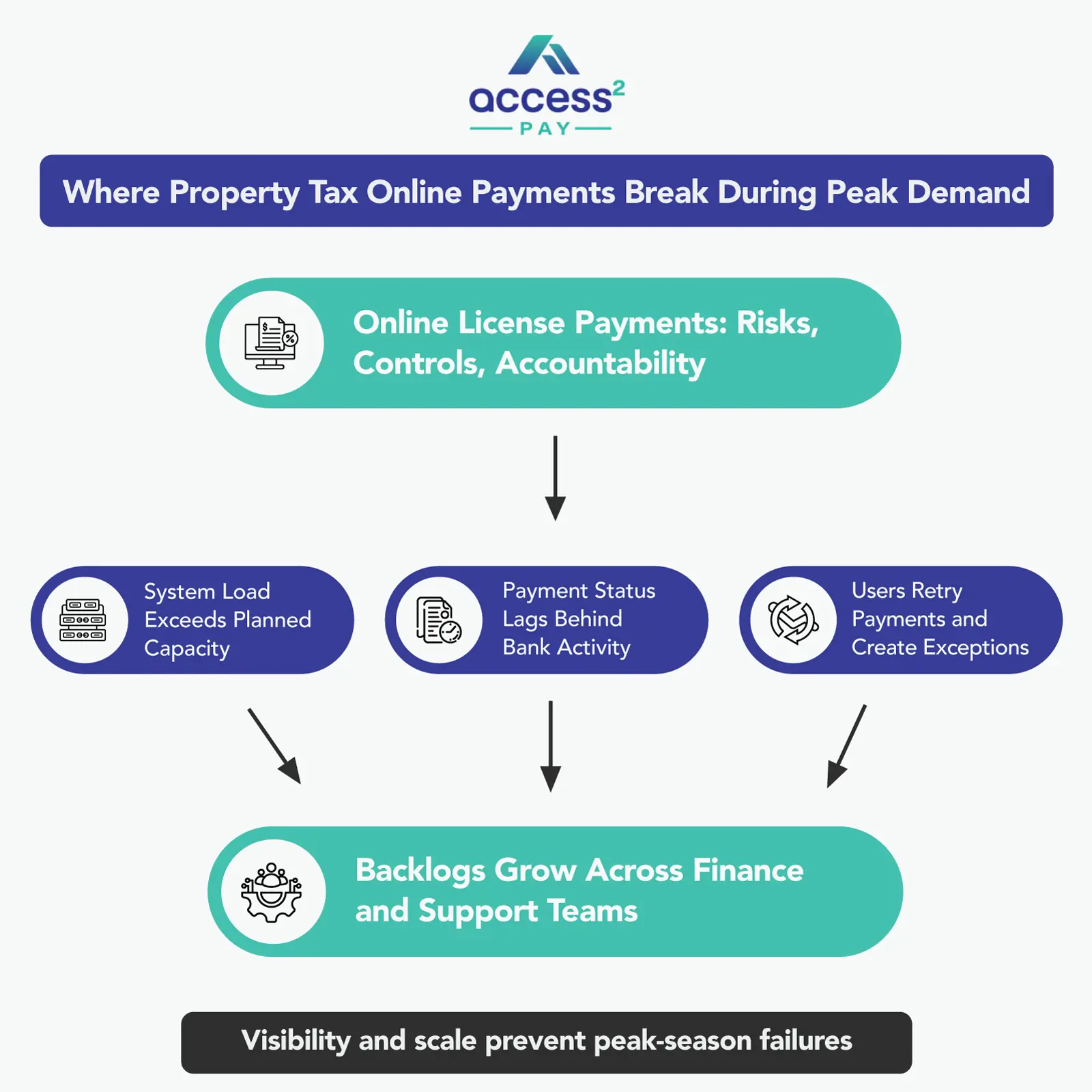
Peak demand reshapes system behavior. What works reliably across normal payment cycles often fails once traffic compresses into a few high-stakes days. Property tax online payment platforms experience sustained concurrency, longer session lifetimes, heavier validation loads, and sharper error sensitivity all at once. Failures emerge when infrastructure, transaction logic, and human support capacity operate on different assumptions about volume and timing. These breakdowns rarely appear in isolation. One failure point amplifies another, creating cascading effects that are difficult to reverse once deadlines arrive.
System Overloads in Property Tax Online Payment Portals
During deadline windows, concurrent sessions multiply rapidly. Thousands of users may enter the portal within minutes, each initiating validation checks, database lookups, and gateway calls. Application servers begin to queue requests as processing threads saturate. Database contention increases as validation logic competes with write operations. Memory pressure grows as sessions persist longer due to slower responses.
Overload rarely results in a full outage. Instead, it presents uneven degradation. Some users complete payments while others encounter delays, blank screens, or forced logouts. This inconsistency drives repeated submissions and refresh attempts, which further increases load. What begins as a performance slowdown escalates into systemic strain driven by user behavior responding to uncertainty.
Timeout and Session Errors in Property Tax Online Payment
Session management assumptions often break under peak demand. Fixed timeout thresholds collide with slower page loads, delayed gateway responses, and longer validation cycles. Multi-step payment workflows exceed session lifespans, especially when users pause to verify amounts or navigate between screens.
Session invalidation creates a dangerous perception gap. From the user’s view, the transaction appears abandoned or failed. From the system’s view, authorization may already exist. This disconnect fuels duplicate submissions, partial records, and reconciliation complexity. The error is not availability. It is a timing misalignment between user activity and system tolerance.
Payment Gateway Bottlenecks for Property Tax Online Payment
Payment gateways face synchronized demand across jurisdictions during tax deadlines. Authorization requests surge not from a single client, but from many government entities at once. Even gateways designed for high throughput experience queuing when volume spikes simultaneously.
Bottlenecks emerge through delayed authorization responses rather than outright failures. Retry logic, intended as a safeguard, can amplify congestion by generating duplicate requests. Inconsistent response timing causes front-end systems to misinterpret gateway state. Gateways may continue operating correctly while appearing stalled to users due to delayed confirmations. The result is perceived failure without transactional loss.
User Input Errors Magnified During Property Tax Online Payment Rushes
Peak demand alters taxpayer behavior. Users rush submissions, skim instructions, and react quickly to perceived delays. Small usability gaps turn into error multipliers. Incomplete fields, mistyped parcel numbers, and repeated submissions increase sharply when response times slow.
Each input error introduces downstream work. Exceptions require validation, correction, or reconciliation after the fact. During peak demand, the volume of these errors overwhelms staff capacity. What would be minor issues under normal conditions become a backlog that persists well beyond deadline dates.
Insufficient Capacity Planning for Property Tax Online Payment Seasons
Capacity planning often relies on average usage rather than peak reality. Systems scale reactively once queues form rather than proactively ahead of deadlines. Load testing frequently underestimates real-world concurrency, session duration, and retry behavior.
Staffing models mirror the same assumptions. Exception handling, support inquiries, and reconciliation volume increase simultaneously with transaction load. Without surge-specific planning, teams face compounding pressure. Even modern platforms struggle to recover momentum once backlogs establish themselves.
Support Channel Congestion Linked to Property Tax Online Payment Issues
Technical friction drives immediate support demand. As payment status visibility weakens, taxpayers seek confirmation through calls, emails, and online forms. Support channels become congested at the precise moment teams face the highest internal workload.
Support teams often lack real-time insight into system state. Without clear visibility into authorization, posting, and settlement stages, staff cannot provide definitive answers. Each inquiry consumes time without resolving root causes. Congestion amplifies operational strain and prolongs recovery.
Posting Delays in Property Tax Online Payment Processing
Posting defines completion in the public mind. Funds may be authorized correctly while status remains unchanged across portals, ledgers, and enforcement systems. During peak demand, posting delays multiply as batch processes extend, reconciliation queues grow, and synchronization intervals stretch. These delays create uncertainty for taxpayers and administrative burden for governments, even when revenue is technically secured.
Batch Posting Lags in Property Tax Online Payment Systems
Batch posting remains common across public finance environments. During high volume, batch windows exceed planned durations. Jobs process more records than expected. Single failed entries pause entire runs. Reconciliation steps delay posting confirmation until downstream checks are complete.
Batch dependency introduces visibility gaps. Payments exist in limbo, authorized and settled yet not reflected in official records. From the taxpayer’s view, the system appears unresponsive. From the finance teams’ view, revenue reporting becomes temporarily unreliable.
Bank Settlement Timing and Property Tax Online Payment Visibility
Authorization confirms availability. Settlement confirms transfer. These steps follow separate timelines governed by banking networks rather than application logic. Visibility gaps arise when portals update only after settlement confirmation.
Different payment methods settle on different schedules. Settlement files arrive in batches rather than continuously. Users often see funds leave their accounts before systems acknowledge receipt. This timing mismatch drives concern, inquiries, and repeated attempts to verify status.
Delayed Status Updates After Property Tax Online Payment Completion
System synchronization often runs on scheduled intervals rather than real-time propagation. During peak demand, synchronization lags widen. Finance systems may update before tax ledgers. Enforcement systems refresh less frequently. Reporting platforms lag further behind.
Inconsistent status across systems undermines confidence. Taxpayers receive mixed signals depending on which interface they check. Staff face difficulty reconciling discrepancies quickly. Each delay increases inquiry volume and manual intervention.
Confirmation Email and Receipt Delays for Property Tax Online Payment
Notification infrastructure faces heavy outbound demand during peak periods. Messaging queues backlog rapidly. Throttling rules slow delivery. Shared infrastructure prioritizes transaction processing over messaging.
Delayed confirmations create uncertainty. Users assume failure in the absence of receipts. Support channels absorb the resulting inquiries. Notification delay becomes a catalyst for operational noise rather than a simple communication issue.
Impact of Posting Delays on Penalties and Interest for Property Tax Online Payment
Penalty assessment logic often relies on posted timestamps rather than received or authorized times. When posting extends beyond deadlines, penalties are calculated automatically even when payment initiation occurred on time.
Manual review becomes necessary to resolve disputes. Appeal volume spikes after deadlines. Staff must trace transaction timelines across systems to correct outcomes. Clear timing protection mechanisms reduce this burden and protect public trust.
Manual Intervention Queues Created by Property Tax Online Payment Delays
Every delay generates exceptions. Payments mismatch parcel records. Duplicate submissions require reconciliation. Enforcement holds trigger reviews. Each exception enters a queue requiring human attention.
Manual queues expand rapidly during peak demand. Staff shift from proactive work to reactive cleanup. Resolution timelines extend weeks beyond deadlines. Operational focus moves away from service improvement toward backlog management.

Making Life Easy With Property Tax Payment Online
Peak demand does not need to translate into disruption. Property tax online payment becomes manageable when systems are designed around predictable stress points rather than average conditions. Ease comes from disciplined structure. When capacity, visibility, and control move together, volume feels routine instead of overwhelming. The result is a payment experience that stays steady for taxpayers and sustainable for internal teams.
Designing for Peak Volume Without Degradation
High-volume periods follow known patterns. Deadlines concentrate activity into narrow windows, creating sustained concurrency rather than short spikes. Systems built for this reality maintain performance without sacrificing accuracy.
Key design principles include:
- Elastic infrastructure capacity that expands ahead of known deadline periods to absorb sustained traffic.
- Load-aware transaction handling that distributes processing evenly instead of letting a single layer saturate.
- Queue prioritization that protects in-progress payments from background tasks during peak load.
When volume planning is intentional, performance remains consistent even under pressure.
Creating Clear Payment Status Visibility at Every Stage
Uncertainty drives frustration more than delay. Taxpayers tolerate processing time when the status remains clear and reliable. Visibility removes the need for guesswork.
Effective status progression includes:
- Stage-based indicators such as received, authorized, posted, and completed.
- Consistent status language shared across portals, emails, and support tools.
- Timestamp transparency that shows when each stage occurred rather than a single completion message.
Clear status reduces inbound support demand and increases user confidence during high-volume periods.
Preventing Errors Before Submission Rather Than After
Most downstream issues originate at intake. Validation that occurs after submission creates rework. Validation that occurs during entry prevents disruption entirely.
Preventive controls include:
- Real-time field validation that blocks incomplete or inconsistent entries before submission.
- Context-aware prompts that guide users through parcel numbers, amounts, and deadlines accurately.
- Pre-submission confirmation views allow users to verify details without restarting the process.
Fewer errors at entry translate into fewer exceptions later.
Automating Exception Handling Without Creating Bottlenecks
Exceptions never disappear during peak demand. What changes outcomes is how they are handled. Automation keeps exceptions contained rather than contagious.
Effective exception management relies on:
- Categorized exception queues that separate simple corrections from complex reviews.
- Automated routing rules that assign ownership instantly instead of waiting for manual triage.
- Full transaction context visibility so staff can resolve issues without searching across systems.
When systems carry the operational load, staff focus on resolution rather than navigation.
Aligning Internal Teams Around a Shared Source of Truth
Ease for the public depends on alignment behind the scenes. When finance, enforcement, and support teams rely on different views of payment status, confusion spreads quickly.
Alignment improves when:
- All departments reference the same transactional data updated in near real time.
- Status changes propagate immediately across enforcement and accounting systems.
- Support teams access live system indicators rather than static reports.
Shared visibility reduces internal friction and shortens resolution cycles.
Scaling Support Without Increasing Noise
Support volume often spikes due to uncertainty rather than system failure. Reducing noise matters as much as increasing capacity.
Noise reduction strategies include:
- Self-service status tracking that answers common questions without human involvement.
- Proactive notifications are tied to posting milestones rather than final completion only.
- Clear escalation paths that prevent repeated inquiries for the same issue.
Lower noise frees support teams to handle true exceptions quickly.
FAQ
Why does my property tax online payment show pending after submission?
Authorization confirms payment method validity. Posting follows settlement confirmation. Timing varies by payment type and processing schedules. Monitoring tools help teams track pending activity accurately.
Can posting delays cause penalties even if I paid on time?
Posting delays can affect penalty calculations when systems rely on posted dates. Many governments review received timestamps during disputes. Clear audit trails reduce resolution time.
How can governments reduce peak demand payment failures?
Preparation includes load testing, capacity planning, and real-time monitoring. Clear status communication lowers support volume. Integrated systems reduce manual intervention during surges.
Stabilizing Property Tax Online Payment When Demand Peaks
Peak demand exposes system reality. Property tax online payment platforms that withstand deadline pressure share one trait: alignment. When intake, gateway processing, posting, and communication move together, volume becomes manageable. Governments that prepare for surge conditions protect revenue, reduce disputes, and deliver consistent service even during their busiest periods.