Payment risk management sits at the centre of how public funds move, settle, and remain accountable. When payments flow across departments, agencies, vendors, and citizens, every transaction carries exposure. Fraud risk. Processing errors. Compliance pressure. Public scrutiny. You see the impact immediately when systems fail. Delays trigger complaints. Errors invite audits. Weak controls erode trust.
You already know this reality. Public sector payments operate at scale, under regulation, with zero tolerance for ambiguity. Payment risk management provides the structure that keeps funds protected while services continue moving. Without it, risk multiplies quietly across systems until it surfaces as a crisis.
This article breaks down how payment risk management works in government environments, the risks it addresses, the strategies that reduce exposure, and how agencies measure success without slowing operations.
Key Takeaways
- Payment risk management protects public funds through structured controls rather than reactive fixes
- Strong frameworks reduce fraud, processing errors, and audit exposure across payment systems
- Measurable risk management practices improve transparency and public confidence
Core Principles of Payment Risk Management in Government
Payment risk management in the public sector relies on discipline, visibility, and accountability. Unlike private commerce, government payments face heightened oversight and long accountability timelines. Every transaction must stand up to review months or years later.
These principles guide how agencies design controls that protect funds while supporting service delivery.
Defining Payment Risk Management Frameworks for the Public Sector
A payment risk management framework sets expectations across systems, teams, and vendors. It defines how risks are identified, assessed, mitigated, and monitored.
In government environments, frameworks align finance, IT, compliance, and operations under shared rules. They document approval paths, escalation triggers, monitoring thresholds, and reporting standards. Without a framework, controls remain inconsistent across departments.
A clear framework turns payment risk management into a repeatable process rather than an ad hoc response.
Identifying Fraud Exposure in Payment Risk Management
Fraud exposure exists in every payment channel. Online portals. Refund workflows. Vendor disbursements. Manual adjustments.
Payment risk management identifies where fraud hides inside routine activity. Small discrepancies across high-volume transactions. Repeated exceptions tied to the same accounts. Unusual refund timing. Detection focuses on patterns rather than isolated events.
You reduce fraud risk by understanding where normal behavior ends and anomalies begin.
Addressing Processing Gaps Through Payment Risk Management
Processing gaps appear when systems fail to align. Authorization completes while posting lags. Settlement clears while records remain outdated.
Payment risk management maps these gaps and assigns controls to each step. Monitoring tools flag delays. Reconciliation rules surface mismatches early. Clear ownership ensures issues are resolved before they affect the public.
Without this structure, gaps remain invisible until complaints arrive.
Ensuring Accountability in Payment Risk Management Operations
Accountability defines who owns each stage of a payment lifecycle. Who approves. Who reviews. Who resolves exceptions?
Payment risk management separates duties to prevent errors and misuse. No single role controls initiation, approval, settlement, and reconciliation. This separation protects staff and strengthens audit defensibility.
Clear accountability also speeds resolution when issues arise.
Regulatory Compliance Within Payment Risk Management
Regulatory obligations shape every payment decision. Data protection. Financial controls. Accessibility requirements. Record retention.
Payment risk management embeds compliance into workflows rather than layering it afterward. Controls align with regulations by design. Documentation exists before audits begin.
Compliance becomes a steady state rather than a scramble.
Stakeholder Roles in Effective Payment Risk Management
Payment risk management succeeds through shared responsibility. Finance teams oversee controls. IT maintains system integrity. Operations manage exceptions. Vendors meet defined standards.
Each stakeholder understands their role and escalation path. This alignment prevents gaps where risk hides between teams.
Key Risks Addressed by Payment Risk Management
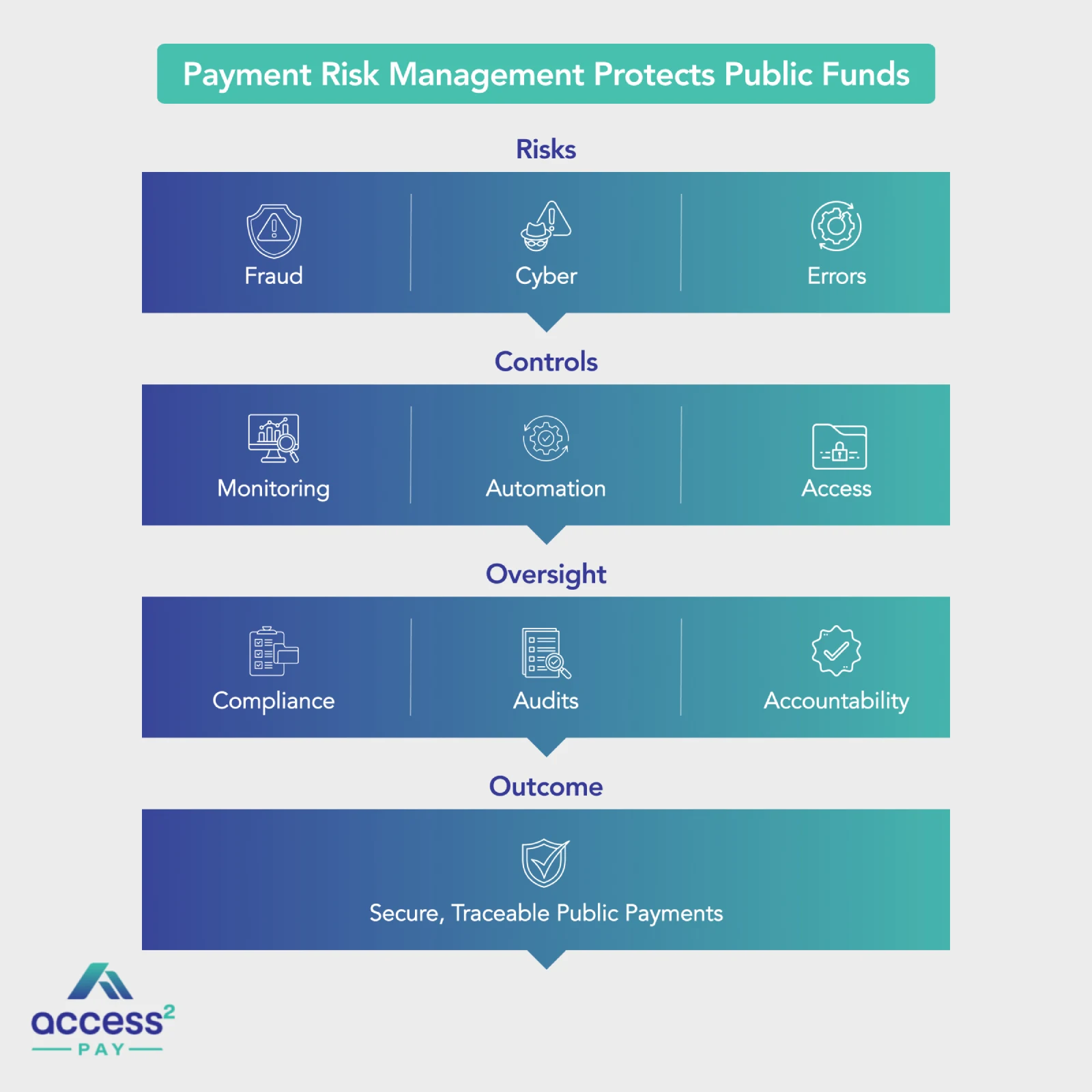
Payment risk management exists to reduce exposure across known risk categories. These risks appear repeatedly across public sector payment environments, regardless of size or jurisdiction.
Fraud Detection Challenges in Payment Risk Management
Fraud adapts to controls. It hides inside volume and routine behavior.
Without payment risk management, fraud detection relies on manual review. That approach misses distributed patterns. Effective risk management uses monitoring, thresholds, and trend analysis to surface irregularities early.
Early detection limits financial loss and investigation costs.
Cybersecurity Threats Impacting Payment Risk Management
Public payment systems attract constant attention. Attack methods evolve continuously.
Payment risk management addresses cybersecurity through layered defenses. Secure access. Monitoring. Incident response planning. When security controls align with payment workflows, exposure drops significantly.
Cybersecurity becomes part of payment governance rather than a separate concern.
Operational Gaps Undermined by Weak Payment Risk Management
Operational gaps emerge when systems lack coordination. Manual workarounds become routine. Exceptions pile up.
Payment risk management identifies these gaps and assigns controls. Automation replaces manual steps where possible. Monitoring highlights backlogs before they escalate.
Operations regain predictability.
Vendor and Third-Party Risks in Payment Risk Management
Vendors play a critical role in public payments. Processors. Software providers. Banking partners.
Payment risk management evaluates vendor controls, certifications, and response obligations. Contracts define accountability. Performance monitoring ensures standards are met over time.
Third-party risk becomes visible rather than assumed.
Data Integrity Issues in Payment Risk Management Processes
Payment data drives reporting, enforcement, and public communication. Inaccurate data undermines all three.
Payment risk management protects data integrity through validation, reconciliation, and controlled access. Errors surface early rather than months later.
Reliable data strengthens every downstream decision.
Financial Accountability Failures Without Payment Risk Management
Without payment risk management, accountability erodes quietly. Funds mispost. Reconciliation delays grow. Audit findings accumulate.
Strong risk management restores confidence. Every transaction traces cleanly from initiation to settlement. Accountability becomes provable rather than assumed.

Strategies for Implementing Payment Risk Management
Payment risk management succeeds when strategies align with how payments actually move through systems and teams. Controls must protect public funds without creating friction that slows service delivery. The goal stays practical. Reduce exposure while keeping transactions efficient and visible.
Effective strategies focus on early detection, consistent execution, and shared accountability. Each element below addresses a specific pressure point within public sector payment environments.
Real-Time Monitoring Tools for Payment Risk Management
Real-time monitoring provides immediate visibility into transaction behavior as it occurs. Instead of reviewing activity after settlement, teams see anomalies during processing. Alerts trigger when volumes spike, thresholds break, or behavior deviates from established patterns.
This visibility allows intervention before issues reach the public. Transactions pause selectively rather than entire systems stopping. Over time, monitoring shifts payment risk management from reactive clean-up to proactive prevention.
Automation in Payment Risk Management Workflows
Automation removes reliance on manual checks that slow processing and introduce inconsistency. Rules apply the same way every time. Exceptions route automatically to the right team based on predefined criteria.
Automated workflows reduce error rates, shorten resolution cycles, and improve throughput during peak periods. Staff focus on investigation and decision-making rather than data movement. Risk management scales across departments without increasing headcount.
Multi-Factor Authentication in Payment Risk Management
Access controls protect the most sensitive payment actions. Multi-factor authentication limits unauthorized access to administrative functions, approval workflows, and configuration settings.
Payment risk management applies authentication based on risk level. High-impact roles receive stronger protection. Routine tasks remain streamlined. Security strengthens while user experience stays efficient for staff and partners.
Training Programs Enhancing Payment Risk Management
Technology supports controls, yet people execute them. Training ensures teams understand how risk management works in practice rather than theory.
Effective programs cover control intent, escalation paths, fraud indicators, and response expectations. Consistent training reduces mistakes during routine operations and improves response speed during incidents. Informed teams form a dependable control layer across systems.
Integration of AI for Proactive Payment Risk Management
AI enhances oversight by identifying patterns across large transaction volumes. It surfaces anomalies that manual review rarely catches, especially when fraud is distributed across many small transactions.
Within payment risk management, AI flags emerging risks early. Teams act before losses accumulate. Oversight improves without adding operational complexity or staff burden.
Vendor Vetting Protocols in Payment Risk Management
Vendors play a direct role in payment processing, data handling, and system availability. Vendor risk requires structured oversight.
Vetting protocols assess security posture, compliance alignment, financial stability, and incident response capability. Ongoing reviews confirm standards remain met over time. Payment risk management treats vendor exposure as continuous rather than a one-time assessment.
Measuring Success in Public Sector Payment Risk Management
Measurement turns payment risk management into an operational discipline rather than a policy exercise. Controls exist on paper in many organizations. Metrics show whether those controls work under real conditions. Without consistent measurement, risk management becomes reactive and improvement stalls.
Public sector leaders need evidence. Evidence supports funding decisions, staffing models, technology investments, and audit confidence. When payment risk management is measured consistently, it becomes easier to defend decisions and demonstrate stewardship of public funds.
KPIs for Evaluating Payment Risk Management Effectiveness
Key performance indicators translate risk management into observable outcomes. Common KPIs track fraud rates, exception volumes, resolution time, reconciliation accuracy, and failed transaction trends.
These indicators reveal patterns over time rather than isolated events. Trends show whether controls reduce exposure or simply move it elsewhere. When KPIs remain visible to leadership, weaknesses surface early and corrective action becomes faster and more targeted.
Audit Readiness Through Robust Payment Risk Management
Audit readiness reflects how well controls operate during normal business rather than how well teams prepare for audits. Systems with strong payment risk management generate complete, consistent records automatically.
Documentation exists as part of daily workflows. Approval paths remain clear. Transaction histories align across systems. Audits shift from discovery exercises to confirmation reviews, reducing disruption and staff stress while improving outcomes.
Incident Response Metrics in Payment Risk Management
Incident response metrics measure how quickly teams identify, contain, and resolve payment-related issues. Response speed matters. Containment time limits exposure. Recovery duration affects public confidence and service continuity.
Tracking these metrics highlights process gaps and training needs. Faster response reduces financial impact, investigation cost, and reputational risk. Over time, improved response metrics signal growing operational maturity.
Cost-Benefit Analysis of Payment Risk Management Investments
Payment risk management requires investment in systems, staff time, and oversight. Those costs become meaningful when compared against avoided losses.
Cost-benefit analysis examines prevented fraud, reduced rework, lower inquiry volume, and faster reconciliation. Efficiency gains often offset control costs within short cycles. Clear analysis helps leadership view risk management as value protection rather than overhead.
Continuous Improvement Cycles for Payment Risk Management
Payment environments change as channels expand and threats evolve. Risk management adapts through structured review cycles.
Regular assessments evaluate control performance, incident trends, and system alignment. Lessons learned feed back into frameworks and workflows. Continuous improvement keeps controls relevant without large disruptive changes.
Reporting Dashboards, Tracking Payment Risk Management Outcomes
Dashboards consolidate metrics into accessible views for executives, finance leaders, and auditors. Visual reporting simplifies complex data into actionable insights.
Clear dashboards support decision-making, justify funding requests, and strengthen public accountability. When leaders see risk trends clearly, confidence increases and governance improves.
FAQ
What makes payment risk management different in government?
Public sector payments require higher accountability, longer audit horizons, and stronger compliance alignment than private commerce. Every transaction must remain defensible months or years after it occurs. Public visibility adds pressure since errors quickly become trust issues. Payment risk management in government focuses on traceability, role separation, and documentation at every stage.
Does payment risk management slow transactions?
Well-designed controls protect funds while maintaining efficient processing through automation and monitoring. Automation removes manual bottlenecks that traditionally caused delays. Real-time alerts surface issues early instead of stopping entire workflows. In practice, mature payment risk management improves speed by reducing rework and exception handling.
How quickly can agencies improve payment risk management?
Improvements begin immediately with visibility tools and structured frameworks that align teams and systems. Early gains often come from monitoring gaps and clarifying ownership rather than large system changes. Automation delivers fast wins by standardizing workflows. Over time, incremental improvements compound into stronger control maturity.
Modernizing Payment Risk Management for Various Payment Gateways
Payment channels continue to expand. Online portals. Mobile payments. Bank integrations. Each gateway introduces new exposure.
Modern payment risk management adapts controls across gateways without fragmenting oversight. Unified monitoring. Consistent validation. Centralized reporting.
When agencies modernize risk management, payments move faster with fewer disputes. Public confidence improves. Audit outcomes strengthen.
Payment risk management remains a cornerstone of public sector trust. It protects funds, supports transparency, and enables services to scale responsibly. When controls align with operations, risk shrinks while performance improves. In the final view, payment risk management turns complexity into control and uncertainty into accountability.