Government payment systems are the infrastructure that moves public money from departments to citizens, suppliers, and other organizations. Most people only see the deposit in their account or a confirmation email. The systems behind that transaction span multiple agencies, banking networks, and compliance layers. In Canada, these systems process hundreds of billions of dollars every business day across direct deposits, wire transfers, and electronic funds transfers.
What Are Government Payment Systems
Government payment systems are the platforms, rules, and infrastructure that public agencies use to send and receive funds. They cover everything from individual benefit payments to large inter-agency transfers and supplier invoices.
In Canada, the systems used by federal departments are built around frameworks set by the Treasury Board of Canada Secretariat and operated through the Receiver General, with settlement flowing through Payments Canada’s national clearing networks.
How They Differ from Private Sector Payment Systems
Government payment systems operate under stricter authorization, audit, and accountability requirements than their private sector equivalents. Every transaction must be tied to an approved budget commitment, a contract, or a legal entitlement.
Payment records must support year-end financial reporting and withstand auditor scrutiny at the transaction level. Private businesses do not face the same legislative framework that requires departments to separate the roles of authorization, payment processing, and receipt confirmation within their own staff.
Who Manages Government Payment Infrastructure in Canada
The Receiver General for Canada, administered through Public Services and Procurement Canada, is responsible for issuing all federal government payments. It processes direct deposits, electronic data interchange payments, large-value wire transfers, and cheques on behalf of federal departments, agencies, and Crown corporations.
Payments Canada operates the clearing networks, specifically the Automated Clearing Settlement System (ACSS) and Lynx, through which those payments are routed and settled with financial institutions across the country.
Why Government Payment Systems Matter
Government payment systems matter because they are the mechanism through which public funds reach the people and organizations that depend on them. Benefit payments, supplier invoices, payroll, and intergovernmental transfers all flow through these systems on fixed schedules.
A failure at any point in the system directly affects citizens waiting for benefits, businesses waiting for payment on contracts, and departments trying to close their accounts on time.
The scale involved makes reliability non-negotiable. According to Payments Canada’s 2024 Annual Report, Canada’s payment systems processed and settled $107 trillion in 2024, averaging more than $424 billion every business day.
Federal government disbursements represent a significant share of that daily flow. System disruptions at the government level do not just affect one transaction; they affect thousands simultaneously.
Government payment systems also matter for accountability. They produce the transaction records that auditors use to verify that public funds were spent correctly.
Without reliable systems, departments cannot demonstrate to Parliament, the Auditor General, or the public that financial controls are working. The payment system is where financial accountability becomes concrete.
Types of Government Payment Systems
Different government payment systems serve different transaction types. No single platform handles everything from small expense reimbursements to multi-billion-dollar intergovernmental transfers. Each system is chosen based on transaction size, speed requirement, and the nature of the payment relationship.
Direct Deposit and EFT Systems
Direct deposit through the Automated Clearing Settlement System (ACSS) is the most commonly used government payment method for recurring, lower-value payments.
Benefit payments, payroll, and supplier invoices under a certain threshold all flow through this channel. It is reliable, cost-effective, and fully traceable. The ACSS settles payments in batches, typically overnight, which means funds reach payees the next business day after the payment file is submitted.
Large-Value Transfer Systems
Lynx is Canada’s high-value payment system and handles time-sensitive, large-value transactions that cannot wait for overnight batch processing.
Government wire payments for intergovernmental transfers, large procurement payments, and same-day financial obligations are routed through Lynx. It settles transactions immediately throughout the business day, which gives departments control over exactly when critical payments are finalized.
Cheque-Based Processes
Cheque payments remain in use for specific transaction types in government, particularly for payees without direct deposit accounts and for certain legacy vendor relationships. The Receiver General issues cheques on behalf of departments, and the physical document is mailed to the payee.
Cheques require more processing time, carry higher operational costs, and generate paper receipt records that must be digitized into the department’s financial system. Their use is declining, but they remain an available channel.
Electronic Data Interchange
Electronic data interchange (EDI) is used by some departments for high-volume, structured payment transactions with large suppliers. EDI transmits both the payment instruction and the remittance information in a standardized format that the supplier’s system can receive and process automatically.
It reduces manual reconciliation on both sides and is common in procurement-heavy departments that manage many ongoing supplier relationships.
How Government Payment Systems Work
Government payment systems move transactions through a defined sequence of stages, from the moment a payment is initiated to the point where it is fully settled and recorded. Each stage involves different systems, different controls, and different participants.
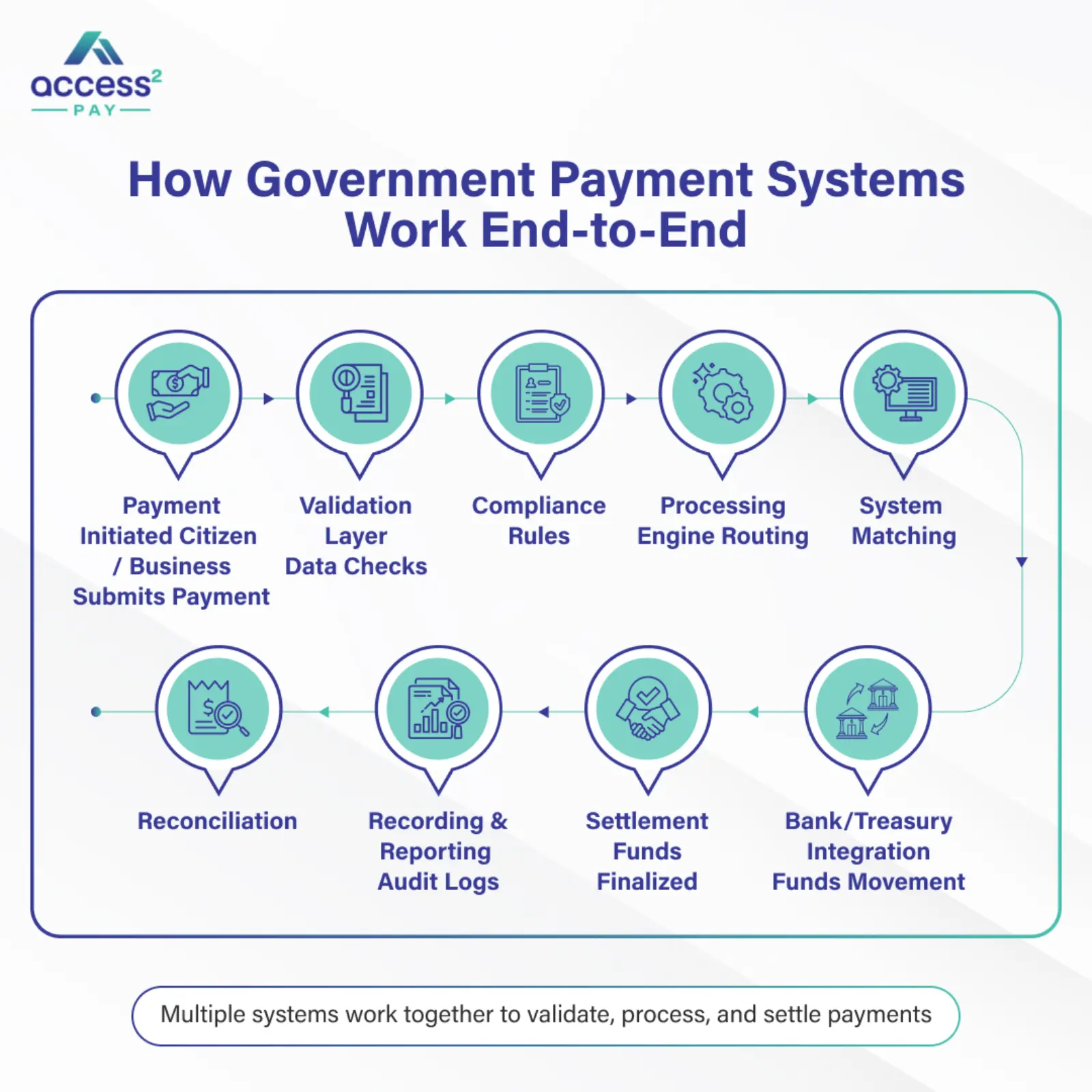
A payment begins when a citizen or business submits a payment request or when a department initiates a disbursement. That submission enters a validation layer where data is checked for accuracy and compliance rules are applied.
Payments that pass validation move into the processing engine, where routing decisions are made and the payment is matched to the appropriate bank and account details. Bank and treasury integration follows, where the payment instruction is transmitted to the government’s banking partner and funds begin moving through the clearing network.
Settlement finalizes the transfer once the bank confirms that funds have reached the destination. Recording and reporting close the cycle by generating audit logs and reconciliation records. Running continuously across every stage are three cross-cutting requirements: security, compliance, and tracking.
These are not discrete steps; they apply at every point in the flow. As the framework states directly, multiple systems work together to validate, process, and settle payments.
Key Components of Government Payment Systems
Government payment systems are made up of several interconnected components that each play a specific role. Understanding what each component does helps departments and service providers identify where issues occur when something goes wrong in the payment process.
- Authorization module: Records that a payment obligation has been approved against a budget, contract, or entitlement before any funds are moved.
- Payment processing engine: Routes confirmed payment instructions to the correct banking channel based on amount, method, and urgency.
- ERP integration: Connects the payment system to the department’s enterprise resource planning platform so that accounts payable, payroll, and contract records update automatically when payment status changes.
- Bank integration layer: Transmits payment files to the government’s banking partner and receives settlement confirmations and payment-advice files in return.
- Clearing network access: Routes payments through ACSS or Lynx, depending on the payment type, with the clearing network handling settlement between financial institutions.
- Reconciliation tools: Match internal confirmation records against bank settlement data after each processing cycle to identify discrepancies before they affect financial reporting.
- Reporting and audit logging: Captures a time-stamped record of every transaction event from authorization through final settlement for audit and compliance purposes.

How Government Agencies Use Payment Systems
Each government agency uses payment systems differently depending on its mandate, payment volume, and payee population. A department that primarily pays suppliers uses accounts payable workflows. A department that delivers benefits to individuals uses a different set of processes tailored to high-volume, recurring payments to citizens.
Benefits and Transfer Payments
Agencies like Employment and Social Development Canada and CRA manage benefit and transfer payment programs that issue thousands of payments on fixed dates each month. These programs use automated payment runs that process eligibility data and generate payment files for the Receiver General.
The Receiver General then routes those files through the appropriate clearing channel. The volume and schedule-driven nature of these programs means that payment system reliability directly affects the lives of recipients who depend on payments arriving on time.
Supplier and Procurement Payments
Departments that purchase goods and services process supplier payments through accounts payable workflows connected to their procurement and contract management systems. An approved invoice triggers a payment requisition, which passes through financial controls before reaching the payment system.
The payment system then generates a payment confirmation, routes the file to the bank, and records the settlement. Supplier payment terms in federal government contracts typically require payment within a defined number of days after invoice receipt, and late payments may trigger interest charges under the government’s prompt payment policies.
Payroll and Employee Payments
Federal public service payroll is processed through the Phoenix pay system, which connects to the Receiver General for direct deposit disbursement. Payroll payment runs occur on a biweekly schedule, and the payment system generates pay statements and tax records alongside each disbursement.
Payroll payment systems must handle deductions, garnishments, and benefit contributions in addition to base pay calculations, which adds complexity to the payment generation and confirmation process.
Challenges and Risks in Government Payment Systems
Government payment systems face challenges that are partly technical and partly organizational. Many of the most persistent issues come from the combination of aging infrastructure, high transaction volumes, and the strict accountability requirements that govern every step of the process.
Legacy System Dependencies
Many federal departments still operate on financial systems that were built decades ago. These legacy platforms were not designed to integrate with modern cloud-based banking and payment services. Connecting them to the current infrastructure requires custom middleware, and updates carry a significant risk of disruption to ongoing payment runs.
Departments often face a choice between maintaining reliable but outdated systems or accepting the disruption risk of modernization. The cost of both options is high, and neither eliminates the underlying vulnerability entirely.
High Volume and Processing Pressure
Payment volumes in government are substantial and concentrated around specific dates. Benefit payment dates, payroll cycles, and fiscal year-end create peaks in transaction volume that test system capacity.
Based on the Government of Canada Annual Financial Report 2024–25, major transfers to persons reached $131.6 billion in 2024–25, representing 24% of all federal expenses. Processing that volume accurately and on schedule requires payment systems that perform consistently under sustained load.
Data Accuracy and Payee Information
Incorrect banking details, outdated addresses, and mismatched identifiers cause payment failures even when the system itself is functioning correctly. A direct deposit that goes to a closed account generates a returned payment that requires manual investigation and reissue.
Keeping payee information current across systems used by multiple departments is an ongoing data management challenge. This affects payment success rates across the federal government.
Compliance and Security in Government Payments
Compliance and security are embedded requirements in government payment systems, not optional features. Every transaction must satisfy authorization controls, privacy obligations, and records retention rules simultaneously. Failure at any of these levels creates both financial and legal exposure for the department involved.
Segregation of Duties
Government financial management frameworks require that the person who authorizes a payment is different from the person who processes it. This segregation of duties is a foundational internal control that prevents fraud and error.
Payment systems are configured to enforce this separation by restricting user roles so that no individual can both approve and execute a payment. Auditors test this control on a sample basis in every financial audit cycle.
Data Protection Requirements
Government payment systems hold sensitive personal and financial information about millions of Canadians. Privacy Act obligations require departments to protect that information from unauthorized access and disclosure. Payment systems that integrate with CRA or ESDC benefit records are subject to particularly strict data handling requirements.
Access controls, encryption, and audit logging are all mandatory in these environments. The Office of the Auditor General has cited deficiencies in system access controls as a recurring finding in its financial audit commentary.
Modernizing Government Payment Systems
Modernization of government payment systems is a recognized priority across the federal public service. The combination of aging infrastructure, evolving payment technology, and increasing transaction volumes creates pressure to update systems that were built for a different era.
The Move Toward Real-Time Payments
Payments Canada is developing a Real-Time Rail (RTR) that will clear and settle payments between financial institutions immediately, around the clock. When integrated with government payment systems, this infrastructure will allow departments to issue same-day payments to citizens and suppliers without relying on overnight batch windows.
Immediate settlement would reduce the gap between payment confirmation and fund availability that currently creates the most common payee inquiries.
Digital Identity and Automated Verification
Modernization also involves improving how government payment systems verify payee identity and banking details before initiating payments. Current processes often rely on manual verification steps that introduce delays and create error risk.
Digital identity frameworks being developed by the Treasury Board Secretariat aim to automate this verification, reducing both the time required to set up new payees and the rate of payment failures caused by incorrect details.
Best Practices for Managing Government Payment Systems
Departments that manage their government payment systems well share a set of operational habits that reduce errors, accelerate issue resolution, and maintain audit readiness throughout the fiscal year.
- Maintain current payee data: Validate banking details and contact information at regular intervals to reduce the rate of returned and failed payments.
- Reconcile at every cycle: Match internal payment records against bank settlement data after each processing run, not just at month or year-end.
- Enforce role-based access: Configure payment systems so that authorization and processing roles are strictly separated and cannot be combined by a single user.
- Log every transaction event: Record a time-stamped entry for every status change from authorization through final settlement to support audit traceability.
- Communicate proactively with payees: Notify payees when their payment status changes, what the next step is, and who to contact if something does not proceed as expected.
- Test system capacity before peaks: Run load tests before major payment dates like benefit runs and fiscal year-end to confirm the system will perform under expected volume.
- Document escalation paths: Define who is responsible for investigating payment failures, within what timeframe, and through what steps when a discrepancy is identified.
Government Payment Systems Are Infrastructure, Not Just Technology
Government payment systems underpin the delivery of public services, the payment of public servants, and the settlement of government obligations to suppliers and citizens across the country. Every component, from the authorization module through the clearing network and into the audit log, serves a specific role in making those payments accurate, traceable, and compliant. Access2Pay supports departments working within this infrastructure by providing the visibility and tools needed to manage payment processing, confirmation, and reconciliation at every stage.