

Business license payment oversight is the structured system of controls, monitoring, and verification that government agencies use to see to it that every license fee is collected accurately, recorded correctly, and processed in full compliance with applicable regulations. Without a reliable framework in place, municipalities and provincial agencies face significant exposure to fraud, revenue leakage, and audit failures that erode both public trust and financial stability. The controls involved in business license payment management cover everything from how individual transactions are monitored in real time to how departments coordinate on compliance audits year after year. Understanding these controls in detail is essential for any government agency looking to modernize its revenue collection and reduce administrative risk.
Key Takeaways
- Effective business license payment oversight requires layered controls: Real-time monitoring, fraud detection, access restrictions, and audit logging must all work together to protect payment integrity at every stage of the transaction lifecycle.
- Accuracy in business license payment depends on validation, matching, and reconciliation: Fee calculation checks, duplicate prevention, and structured error resolution workflows allows that every payment collected matches exactly what the business owes, reducing disputes and improving revenue reliability.
- Compliance with business license payment regulations is an ongoing operational responsibility: Regulatory alignment, retention policies, cross-department coordination, and annual audits are not one-time tasks; they require consistent institutional practice and staff training to remain effective.
Oversight Controls for Business License Payment
Oversight controls for business license payment are the mechanisms that government agencies use to maintain visibility, security, and accountability across every transaction processed through a licensing system. Effective oversight does not begin after a problem surfaces; it operates continuously in the background, catching irregularities before they escalate. Agencies using modern government payment solutions from Access2Pay have access to integrated tools that support real-time monitoring, automated fraud detection, and role-based access controls, all from a single platform designed for public-sector compliance requirements.
Real-Time Monitoring of Business License Payment Transactions
Real-time monitoring tracks every business license payment transaction as it occurs, giving administrators immediate visibility into payment status, amounts, and processing flags. This continuous oversight layer makes it possible to identify payment discrepancies, processing delays, or unusual activity patterns the moment they appear, rather than discovering them during a monthly reconciliation cycle.
- Live transaction dashboards: A real-time monitoring system displays all in-progress and completed business license payment transactions in a single view, allowing finance teams to spot anomalies without pulling individual records.
- Automated status alerts: When a business license payment transaction triggers a predefined threshold, such as an unusually high fee or a payment method mismatch, the system generates an immediate alert for review before the transaction is finalized.
- Cross-channel visibility: Modern monitoring tools consolidate business license payment data from online, in-person, and mobile payment channels into one auditable stream, removing the blind spots that siloed systems create.
Fraud Detection Protocols in Business License Payment
Fraud detection protocols in business license payment systems are rule-based and machine-learning-driven processes that flag suspicious transactions for human review before they clear. According to the U.S. Department of the Treasury, enhanced fraud detection measures in fiscal year 2024 prevented and recovered over $4 billion in fraudulent and improper payments, a figure that underscores the financial significance of deploying active detection systems rather than relying on post-payment audits.
- Pattern recognition rules: Fraud detection engines compare each incoming business license payment against historical transaction patterns, flagging submissions that deviate significantly from a business’s payment history or that match known fraud signatures.
- Velocity checks: When multiple business license payment attempts are submitted in a short time window from the same account or IP address, velocity rules automatically hold those transactions for manual verification.
- Third-party identity verification: Integrating business registration databases with payment processing systems allows agencies to verify that a business license payment is being submitted by a legitimate, registered entity before the payment is accepted.
Access Restrictions for Business License Payment Systems
Access restrictions limit who within a government agency can view, process, approve, or modify business license payment data, reducing the risk of internal fraud and unauthorized changes. Role-based access control assigns specific permissions to individual staff positions, so a payment processor cannot approve their own transactions, and a department manager cannot alter payment records without a secondary authorization.
- Role-based permissions: Each staff role in the business license payment system is assigned a defined set of capabilities; data entry staff can initiate payments, supervisors can approve exceptions, and auditors can read all records without modifying any of them.
- Multi-factor authentication: All users accessing the business license payment platform from outside the agency’s internal network must pass multi-factor authentication, protecting against credential-based intrusion attempts.
- Session timeout and audit trails: Automatic session termination after periods of inactivity, combined with a complete log of every access event, see to it that the access restriction framework remains enforceable and reviewable.
Audit Logging for Business License Payment Activity
Audit logging creates a permanent, tamper-evident record of every action taken within the business license payment system, from payment submission through processing, approval, and settlement. This log is the evidentiary backbone of any internal or external compliance audit, and it must be comprehensive enough to reconstruct the full history of any individual transaction on demand.
- Immutable event records: Every create, read, update, and delete action affecting a business license payment record is written to an append-only audit log that cannot be modified by any user, including system administrators.
- Timestamp and user attribution: Each log entry captures the precise timestamp, the user account responsible, the action performed, and the before-and-after state of any changed data, giving auditors a complete chain of custody for each business license payment record.
- Log retention alignment: Audit logs for business license payment activity must be retained in accordance with the jurisdiction’s statutory record-keeping requirements, which in many Canadian provinces extend to seven years for financial transaction records.
Exception Reporting in Business License Payment Oversight
Exception reporting surfaces business license payment transactions that fall outside normal parameters, presenting them to supervisors or compliance officers for review rather than allowing them to process automatically. Exceptions can include overpayments, underpayments, payments submitted after a license expiry, or transactions that fail validation checks.
- Configurable exception thresholds: Agencies can define specific tolerance bands for business license payment amounts; transactions that fall above or below those bands are automatically routed to an exceptions queue rather than cleared for processing.
- Escalation workflows: Unresolved exceptions in the business license payment system trigger automated escalation after a defined period, ensuring that no flagged transaction is left in a pending state indefinitely without supervisory review.
- Exception trend analysis: Reviewing exception patterns over time reveals systematic issues in the business license payment process, such as a recurring fee calculation error for a specific license category, that individual exception reviews might not surface.
Vendor Management for Business License Payment Gateways
Vendor management secures the third-party payment gateways and processors handling business license payment transactions are contractually obligated to meet the same security, compliance, and uptime standards that the government agency applies to its own systems. Platforms like Access2Pay’s municipal payment system are built with PCI-DSS compliance and deep integration capabilities that eliminate the vendor management gaps that arise when agencies rely on consumer-grade payment processors not designed for public-sector accountability requirements.
- Contractual compliance requirements: Every vendor involved in business license payment processing must meet PCI-DSS standards at minimum, with contracts specifying audit rights, breach notification timelines, and liability allocation for processing failures.
- Regular vendor performance reviews: Quarterly reviews of gateway uptime, error rates, and fraud incident reports keep vendor performance measurable and create a documented basis for contract renewal or replacement decisions.
- Integration testing after updates: Any update to a vendor’s payment processing platform must pass integration testing against the agency’s business license payment workflows before deployment to production, preventing processing disruptions from untested changes.
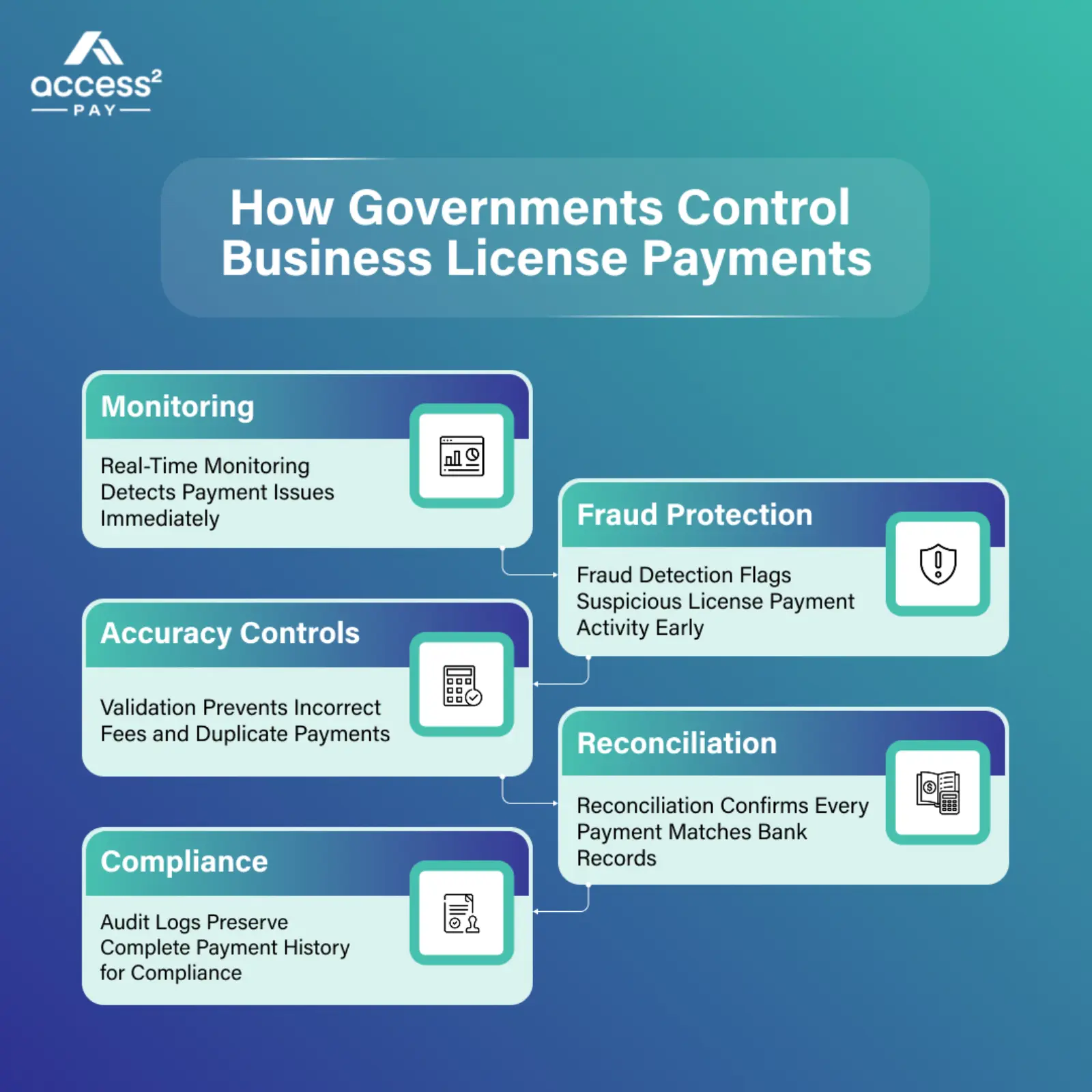
Securing Accuracy in Business License Payment
Accuracy in business license payment is not a passive outcome of good intentions; it is the product of deliberate technical controls that validate fees before they are charged, match payment data against authoritative records, and systematically catch discrepancies before they become disputes. A 2025 compliance report by Sprinto found that 85% of companies say compliance has become more complex over the past three years, and 40% of compliance teams still run processes with basic tools like spreadsheets. For government agencies processing high volumes of business license payment transactions, manual tools are a structural accuracy risk that modern payment systems are specifically designed to remove.
Fee Calculation Validation for Business License Payment
Fee calculation validation confirms that the amount charged for each business license payment matches the correct fee schedule for that license type, jurisdiction, and business classification before the transaction is initiated. This step eliminates the most common source of business license payment errors, which is the application of an incorrect fee tier.
- Automated fee schedule lookups: The payment system queries the current fee schedule database in real time for each business license payment initiation, applying the correct rate for the license category and any applicable adjustments such as late fees or exemptions.
- Fee schedule version control: When municipal councils update business license fee structures, the payment system maintains a complete version history so that transactions can be retroactively validated against the rate that was in effect at the time of payment.
- Override logging: Any manual fee adjustment to a business license payment must be logged with the authorizing user, the reason for adjustment, and the approval chain, creating a complete record of every deviation from the standard fee schedule.
Data Matching Rules in Business License Payment
Data matching rules cross-reference the information submitted with each business license payment against the authoritative records held in the business registry, tax database, and licensing department, confirming that the payment details align with the account they are intended to settle.
- Business registration number validation: Each business license payment submission is checked against the active business registry to confirm that the registration number is valid, active, and associated with the correct entity before the payment is accepted.
- Address and classification matching: The business address and license classification submitted with a payment are matched against the licensing database to guarantee that the correct fee tier is being applied for the correct location and business type.
- Payee name reconciliation: Automated name matching compares the payee information on each business license payment against the registered business name, flagging discrepancies that could indicate payment to the wrong account or potential fraud.
Duplicate Prevention for Business License Payment
Duplicate prevention controls secures that the same business license payment obligation is not settled twice, which would result in either a revenue shortfall if the duplicate is credited to the wrong account, or an overpayment dispute if both transactions are processed against the same license.
- Transaction deduplication checks: Before any business license payment is finalized, the system checks for an existing transaction with the same reference number, amount, account, and submission date within a defined lookback window.
- Business license reference locking: Once a business license payment is submitted and in process, the associated license reference is locked to prevent any additional payment submissions against the same obligation until the first transaction is fully settled or voided.
- Duplicate alert notifications: When a potential duplicate business license payment is detected, both the submitting party and the agency’s payment administrator receive an immediate notification, allowing the issue to be resolved before either transaction clears.
Adjustment Handling in Business License Payment Processes
Adjustment handling covers the controlled process for modifying a business license payment that has been incorrectly assessed, partially applied, or submitted against the wrong account. Adjustments require a formal approval workflow rather than direct database edits to prevent unauthorized changes to payment records.
- Structured adjustment request workflow: Any modification to a posted business license payment must follow a documented request-review-approve process, with the original payment record preserved and the adjustment recorded as a separate, linked transaction.
- Supervisor authorization requirements: Adjustments above a defined dollar threshold require supervisor sign-off before they are applied, ensuring that large corrections to business license payment records receive appropriate scrutiny.
- Adjustment impact on reconciliation: All approved adjustments are automatically reflected in the reconciliation reports for the affected period, so that period-end totals remain accurate without requiring manual recalculation of previously closed batches.
Reconciliation Checks for Business License Payment Accuracy
Reconciliation checks verify that the total value of business license payment transactions recorded in the payment system matches the actual funds received in the government’s bank or treasury accounts, and that individual license accounts reflect the correct balance after every settlement cycle.
- Daily batch reconciliation: At the close of each processing day, the system automatically reconciles the total of all settled business license payment transactions against the bank deposit record, generating a variance report for any items that do not match.
- Account-level balance verification: Each business license account is reconciled individually at renewal time, confirming that all outstanding business license payment obligations have been settled before the new license period begins.
- Interbank settlement confirmation: For business license payment transactions processed through electronic fund transfers, the system receives and records settlement confirmation from the financial institution, closing the reconciliation loop with an external verification point.
Error Resolution Workflows for Business License Payment
Error resolution workflows define the specific steps, roles, and timelines for investigating and correcting business license payment errors that survive initial validation controls. A documented resolution process making sure that errors are handled consistently, communicated to affected businesses promptly, and closed with a verifiable audit trail.
- Error classification and routing: Payment errors are categorized by type, such as calculation errors, misapplied payments, or failed transactions, with each category routed to the team best positioned to resolve it within a defined service level.
- Business communication standards: When a business license payment error requires action from the business owner, the agency sends a formal notification through the payment portal with a clear description of the issue, the correction required, and the deadline for resolution.
- Error closure documentation: Every resolved business license payment error is documented with the root cause identified, the corrective action taken, the approvals obtained, and the date of final resolution, creating a reference record for future audits.

Compliance Requirements for Business License Payment
Compliance requirements for business license payment extend well beyond the transaction itself, covering how agencies report revenue, retain records, coordinate across departments, and prepare for regulatory review. According to the U.S. GAO, federal agencies identified $162 billion in improper payments in fiscal year 2024 alone, with most of those errors concentrated in a small number of programs that lacked sufficient internal controls. For municipal and provincial governments managing business license payment programs, the lesson is direct: compliance is a system-level responsibility, not a departmental checkbox.
Regulatory Alignment in Business License Payment Systems
Regulatory alignment means that every component of the business license payment system, from fee schedules and payment methods to data storage and reporting formats, conforms to the current requirements set by the relevant provincial, state, or federal authority. The Access2Pay provincial payment platform is built to maintain PCI-DSS compliance and regional privacy regulation adherence, providing agencies with a compliant infrastructure that does not require in-house regulatory tracking to keep current.
- Jurisdiction-specific fee rule libraries: Business license payment systems operating across multiple municipalities must maintain separate, jurisdiction-specific fee rule sets that reflect each local government’s current bylaws and license categories.
- Privacy regulation compliance: Business registration data collected during business license payment processing must be handled in accordance with applicable privacy legislation, including data residency requirements and restrictions on sharing personal information with third parties.
- Payment method compliance: Accepted payment methods for business license payment transactions must align with the government’s financial policies and any regulatory requirements governing the acceptance of electronic payments, bank transfers, or digital wallets for public revenue collection.
Reporting Standards for Business License Payment Revenue
Reporting standards define how business license payment revenue is categorized, summarized, and presented in the agency’s financial statements and government performance reports. Consistent reporting standards make it possible to compare revenue performance across periods, identify collection shortfalls, and satisfy the disclosure requirements of public finance legislation.
- Revenue classification codes: Each business license payment transaction is assigned to the correct revenue classification code at the time of processing, ensuring that period-end reports accurately reflect the composition of licensing revenue by category and program.
- Accrual versus cash reporting alignment: Agencies using accrual-basis accounting must guarantee that their business license payment reporting system can correctly allocate license fee revenue to the period in which it was earned, not only to the period in which payment was received.
- Intergovernmental reporting obligations: Where business license payment revenue is shared between municipal and provincial governments, the reporting system must generate the specific breakdowns and certifications required by each level of government within the defined submission timelines.
Retention Policies for Business License Payment Records
Retention policies establish how long business license payment records must be kept, in what format, and under what security conditions. These policies are driven by statutory requirements that vary by jurisdiction and record type, but they share a common purpose: ensuring that transaction records remain available for audit, dispute resolution, and regulatory review for as long as required by law.
- Minimum statutory retention periods: Most Canadian provinces require financial transaction records, including business license payment history, to be retained for a minimum of seven years, with some categories of records subject to longer retention periods under specific legislation.
- Secure archive standards: Retained business license payment records must be stored in tamper-evident, access-controlled archives that prevent unauthorized modification or deletion while remaining accessible for authorized review throughout the retention period.
- Disposition procedures: When the retention period for a business license payment record expires, the record must be disposed of through a documented process that meets the privacy and security requirements applicable to government financial data.
Cross-Department Coordination on Business License Payment
Cross-department coordination secures that the finance, licensing, IT, and legal departments involved in business license payment administration are working from the same data, applying the same rules, and communicating through defined channels when issues arise. Without coordination structures, the same business license payment discrepancy can be handled differently by different departments, creating inconsistent outcomes and compliance gaps.
- Shared data access protocols: All departments involved in business license payment administration should have read access to a single authoritative transaction record, eliminating the need for departments to maintain their own parallel records that can diverge over time.
- Inter-departmental escalation paths: When a business license payment issue requires resolution by more than one department, a documented escalation path assigns lead responsibility and sets timelines for each department’s contribution to the resolution.
- Regular coordination meetings: Scheduled inter-departmental reviews of business license payment performance, exception trends, and compliance status keep all relevant teams aligned and provide a structured forum for resolving operational disagreements before they affect compliance outcomes.
Annual Compliance Audits of Business License Payment
Annual compliance audits of business license payment processes provide a structured, independent review of how well the agency’s payment controls, accuracy measures, and regulatory alignment are performing against required standards. Audits identify control gaps, measure the effectiveness of remediation efforts from prior years, and produce a documented record of compliance status for senior leadership and oversight bodies.
- Internal audit scope definition: The annual business license payment audit should cover the full scope of payment controls, including monitoring systems, access restrictions, reconciliation accuracy, and regulatory alignment, rather than sampling only a subset of compliance areas.
- External auditor access: Where regulatory requirements or governance policies call for independent verification, external auditors must be granted full access to business license payment records, system logs, and configuration documentation for the audit period.
- Audit finding remediation tracking: Every finding from the annual business license payment audit must be assigned to a responsible team with a documented remediation plan and a target completion date, with progress reviewed at defined intervals between annual audits.
Training Programs for Business License Payment Compliance
Training programs guarantees that every staff member involved in business license payment administration understands their specific compliance responsibilities, knows how to use the payment system correctly, and is current on any regulatory changes that affect how payments must be processed or recorded.
- Role-specific onboarding training: New staff in any role that involves business license payment processing, approval, reporting, or auditing must complete role-specific compliance training before receiving system access, reducing the likelihood of procedure errors during the learning period.
- Annual compliance refreshers: All existing staff with business license payment responsibilities complete annual refresher training that covers updates to applicable regulations, changes to fee schedules or processing procedures, and lessons learned from exceptions and errors identified during the prior year.
- Competency verification: Training completion is documented and competency is verified through practical assessment, creating a record that demonstrates the agency’s commitment to trained staff as part of its overall business license payment compliance program.

Frequently Asked Questions
What is the most common reason business license payment reconciliation fails?
The most common cause of business license payment reconciliation failure is a data matching breakdown between the payment processing system and the licensing database, typically resulting from manual data entry errors, outdated fee schedules, or unsynchronized system updates. When these two systems operate on different data, the reconciliation process produces variances that require manual investigation to resolve, consuming staff time and introducing delays into the financial close cycle. Agencies that integrate their payment platform directly with their licensing and billing databases through a solution like Access2Pay significantly reduce this risk by eliminating the manual data transfer step that is the primary source of reconciliation discrepancies.
How often should a government agency conduct compliance audits of its business license payment system?
Annual audits are the standard minimum for business license payment compliance, but agencies with high transaction volumes, recent system changes, or prior audit findings should conduct supplementary internal reviews on a quarterly or semi-annual basis. The purpose of more frequent reviews is not to satisfy a regulatory requirement but to catch control gaps early, before they have had a full year to generate compounding errors or fraud exposure. Annual compliance audits should be complemented by continuous monitoring through real-time dashboards and regular exception reporting, which together create an ongoing compliance posture rather than a point-in-time snapshot.
What should a government agency look for when selecting a business license payment platform?
The most important criteria are PCI-DSS compliance, integration capability with existing licensing and financial databases, real-time reporting and audit logging functionality, and demonstrated experience with public-sector clients. An agency should also evaluate the vendor’s support model, specifically what training is provided for staff at onboarding, what ongoing assistance is available, and what the vendor’s process is for regulatory updates that require system changes. Access2Pay’s government payment solutions meet each of these criteria, offering deep integration with municipal and provincial databases, built-in fraud detection, 24/7 support, and a compliance-first architecture designed specifically for public-sector revenue collection.
Understanding More of the Business License Payment for Better Business Control
A well-managed business license payment program is not an administrative back-office function. It is a core component of government financial integrity, public trust, and operational efficiency. The oversight controls, accuracy measures, and compliance frameworks described in this article represent the full scope of what a government agency must have in place to process business license payment transactions reliably, detect problems quickly, and demonstrate to auditors and the public that public revenue is being handled responsibly. Each layer of control, from real-time monitoring and fraud detection through fee validation, reconciliation, and annual audits, reinforces the others, creating a system that is far more resilient than any individual control could be on its own.
Agencies that have historically relied on legacy systems or manual processes for business license payment management are facing increasing pressure from regulatory expectations, rising fraud sophistication, and the growing complexity of multi-department coordination. Modern platforms purpose-built for government revenue collection, such as the Access2Pay government payment suite, address these pressures directly by automating the controls that manual systems cannot sustain at scale. Understanding the full architecture of business license payment oversight is the first step toward building it; the second step is implementing the right infrastructure to make it operationally sustainable.
Sources
-
-
IBM Security. (2024). Cost of a data breach report 2024. Cited in: Accutive Security.
https://accutivesecurity.com/data-breach-statistics-2024-penalties-and-fines-for-major-regulations/
-
U.S. Department of the Treasury. (2024, October 9). Treasury announces enhanced fraud detection processes, including machine learning AI, prevented and recovered over $4 billion in fiscal year 2024.
-
U.S. Government Accountability Office. (2025, March 11). Improper payments: Information on agencies’ fiscal year 2024 estimates. GAO-25-107753.
-
Sprinto. (2025). 100+ compliance statistics you should know in 2025.
-
Alloy. (2024). 2024 state of fraud benchmark report.
-
Federal Trade Commission. (2025, March). New FTC data show a big jump in reported losses to fraud to $12.5 billion in 2024.
-
Access2Pay. (2025). Comprehensive payment solutions for government agencies.
-
Access2Pay. (2025). Efficient municipal payments with Access2Pay.
https://access2pay.com/government-payments/municipal-government/
-
Access2Pay. (2025). Provincial payment system for state and local services.
https://access2pay.com/government-payments/provincial-and-state-government/
-
