Artificial intelligence in payments is rapidly changing how businesses manage speed, security, and transaction accuracy. You’re not just seeing faster checkouts; you’re watching entire systems adapt in real time. If you’ve ever wondered why fraud attempts are caught quicker now or why some payments seem to predict themselves, AI is the reason.
Key Takeaways:
- AI improves payment processing by detecting fraud, verifying identity, and reducing errors in real time.
- Predictive models and automation help businesses optimize operations and personalize payment experiences.
- Ethical and regulatory hurdles remain, though the pace of AI adoption continues to rise.
How the Digital Payments Industry is Adapting to AI Innovations
It’s not just tech companies driving these changes. Retailers, banks, and payment processors have all started weaving AI into their infrastructure. They aren’t experimenting; they’re investing. From reducing operational bottlenecks to improving consumer trust, the AI wave is now central to payment strategies.
The Growing Role of AI in Payment Technology
You may have noticed a subtle shift. A few years ago, machine learning in finance felt like a sandbox, lots of potential, not much structure. Now it’s operational. Fraud detection, transaction routing, and identity verification they’ve all evolved into AI-enhanced tools. You’re no longer waiting for reports to show a pattern. The system detects that pattern in motion, sometimes before anyone knows there’s something to detect. That speed feels new. It’s not just reactionary; it’s predictive.
The pressure to adapt is intense. Legacy systems can’t keep up with how quickly fraud tactics evolve. AI gives companies something closer to foresight. Not perfect, no, but definitely better than guesswork or waiting for alerts that arrive too late.
Key Trends Shaping AI Adoption in Digital Transactions
What’s driving this momentum? It’s layered, but three major shifts come to mind:
- The overwhelming volume of digital payments makes manual oversight unsustainable. One spike in volume and human-led processes fall behind.
- Consumers expect instant payments that are also perfectly secure. That’s a high bar. AI helps meet it without sacrificing one for the other.
- The evidence speaks loudly. AI doesn’t just spot fraud, it adapts. It learns and sharpens its pattern recognition with each new data point.
The result? AI in payments has moved from an emerging tech to a mission-critical layer in the modern payment stack. Not using it feels like leaving your doors unlocked, while hoping no one checks.
The Role of Artificial Intelligence in Digital Payments
We used to rely on manual checks and rule-based systems. Today, AI builds on historical data to flag outliers, recommend actions, and streamline the entire transaction process. It doesn’t replace human judgment completely, but it adds a layer of efficiency that humans alone couldn’t achieve.
How AI Improves Transaction Accuracy and Fraud Detection
Let’s say someone tries to make a purchase from two different locations within 60 seconds. Instead of declining the transaction automatically, an AI model might check the user’s travel history, device data, and past behavior. It considers more than rules, it makes informed judgments.
Machine Learning for Personalized Payment Experiences
You’ve probably seen this in your own life. Some apps suggest payment options based on your habits. Other times, their prompts are based on when you’re most likely to transact. These aren’t coincidences. Machine learning models shape those interactions.
AI-Powered Risk Assessment in Payment Systems
There’s risk in every payment. What AI does well is reduce uncertainty by spotting patterns, even the faint ones. It doesn’t need to know everything, it just needs enough data to find signals. That makes AI a powerful ally in understanding transaction intent, segmenting behavior, and forecasting threat levels with remarkable precision.
Key functions of AI in payment risk assessment include:
- Mapping historical fraud patterns across similar user groups
- Clustering transactions to identify abnormal spikes or rare patterns
- Evaluating device, browser, and IP fingerprint mismatches
- Gauging emotional tone in support chats or customer inquiries using NLP
- Weighing geographic and behavioral anomalies before scoring risk
Identifying High-Risk Transactions with Machine Learning
These models look at location, amount, frequency, merchant type, device info, and dozens of other factors. And the systems get better over time. They don’t just learn, they refine. Which means you’re catching more fraud, faster, with fewer false alarms.
AI in Payment Processing: Improving Speed and Security
Speed and security used to be trade-offs. If you wanted faster transactions, you risked skipping checks. If you wanted safer ones, you had to slow things down. AI changes that balance. It brings automation and insight into places that used to require manual review. You’re not just accelerating payments, you’re making them smarter.
Automating Payment Verification and Fraud Prevention
AI can flag, route, or even halt a transaction in milliseconds. You’re no longer relying on manual approvals or outdated scripts. Everything happens in motion, behind the scenes. The system learns continuously, drawing from recent data to adapt its responses.
Key AI capabilities for verification and fraud prevention include:
- Real-time monitoring of payment activity across multiple channels
- Instant comparison of transaction behavior against user history
- Integration with device fingerprinting and geolocation for added context
- Use of natural language processing to detect suspicious communication patterns
- Dynamic rule adjustments based on current threat levels
Reducing Transaction Errors with AI-Driven Analytics
Mistyped account numbers, wrong dates, mismatched billing info, these used to cause delays or failed payments. AI systems now catch those errors before they cause friction. You save time, your customers stay happy, and your reconciliation becomes cleaner. But the real win is consistency, AI never tires, never skips steps.
AI-driven analytics reduce transaction errors by:
- Validating fields against historical and real-time input standards
- Predicting likely corrections based on context (e.g., correcting a date format)
- Flagging data mismatches before transactions are finalized
- Identifying patterns of recurring errors and suggesting workflow changes
- Offering real-time feedback loops to refine accuracy continuously

How AI and Payments Are Reshaping the Digital Transaction Landscape
This shift isn’t only technical. It’s strategic. AI adoption changes how teams think about risk, customer experience, and long-term infrastructure planning. It forces a new kind of agility. Operations that were once siloed, such as compliance, fraud, and customer service, are becoming interconnected through AI-driven insights. That interconnectivity leads to smarter product development and more responsive decision-making at every level.
Major ways AI is reshaping payments include:
- Creating real-time dashboards that guide executive strategy and operations
- Merging fraud detection with marketing behavior analysis for more personalized journeys
- Streamlining dispute resolution by predicting outcomes before escalation
- Powering dynamic pricing engines based on transaction history and intent
- Coordinating internal workflows to route flagged issues faster across departments
The Impact of AI on Customer Experience in Payments
A smooth experience is often invisible. You tap, it works. What you don’t see is the AI checking ten variables in a second. That seamlessness boosts confidence and loyalty. Customers start expecting it everywhere.
Real-Time Decision Making for Faster Transactions
Real-time approvals used to mean high error rates. Now, AI lets you make smarter decisions in the moment. You can approve, flag, or re-route payments without slowing anyone down. These decisions aren’t arbitrary, they’re built from millions of signals, processed in milliseconds, and continuously refined.
Examples of real-time AI decision-making capabilities:
- Approving payments instantly based on learned customer profiles
- Flagging subtle transaction shifts that manual teams might miss
- Rerouting payments through secondary gateways to reduce failure risk
- Adjusting transaction flow based on network performance and system loads
- Surfacing priority transactions for manual review before delays occur. Now, AI lets you make smarter decisions in the moment. You can approve, flag, or re-route payments without slowing anyone down.
The Future of AI in Cross-Border and Real-Time Payments
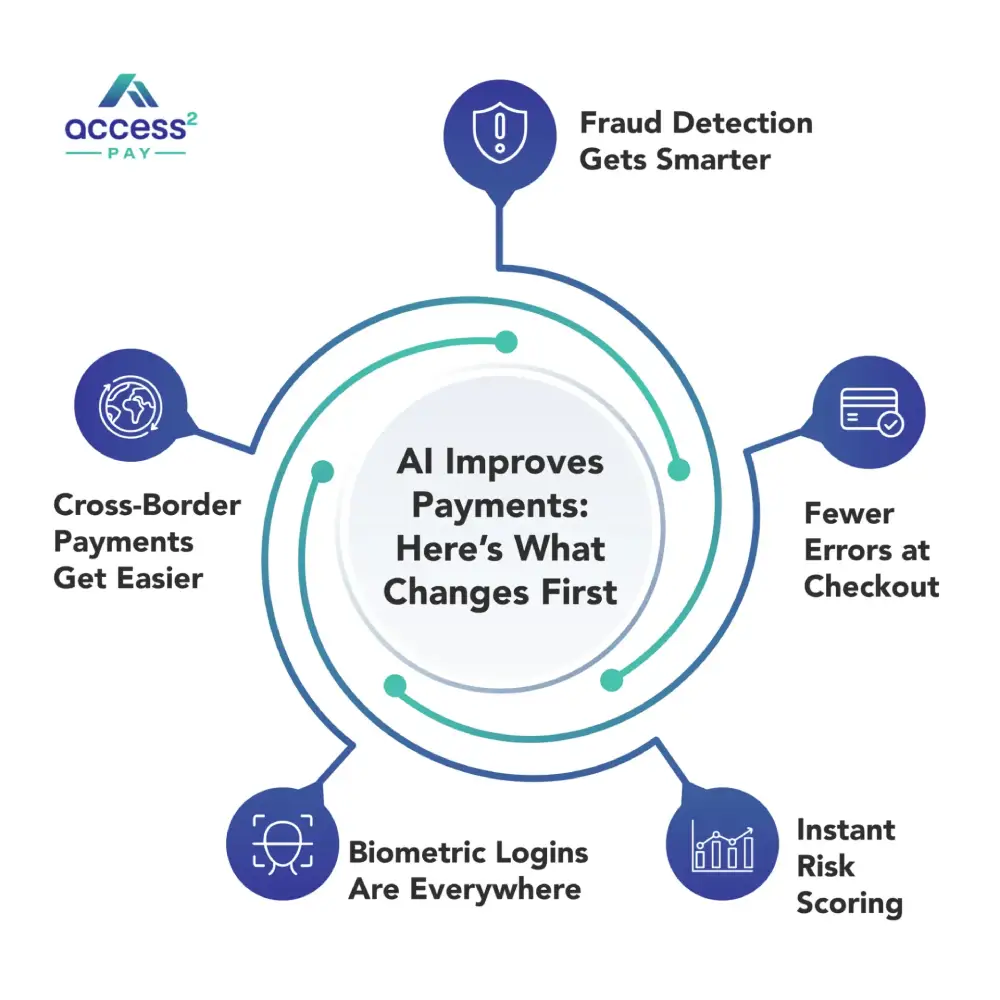
Cross-border payments are messy, with different currencies, banks, and laws. Each region has its own financial standards, compliance requirements, and banking protocols. These complexities slow down transactions and introduce risk. AI doesn’t eliminate the mess entirely, but it creates order within it. Through automation and data modeling, AI can handle everything from currency conversion to fraud flagging without constant human intervention.
Businesses sending or receiving payments globally now expect seamless transactions, and AI is helping to deliver them. AI allows for fast regulatory checks, dynamic routing based on fees or speed, and continuous fraud monitoring across geographies.
Key capabilities include:
- Real-time currency exchange rate optimization
- Automated compliance checks that adapt to regional regulations
- Intelligent routing for the fastest and most cost-effective payment paths
- Cross-border fraud detection based on global transaction behavior
- Reduced settlement times and improved payment traceability
AI-Driven Payment Authentication and Biometric Security
Passwords aren’t enough anymore. They’re easy to forget, easy to guess, and even easier to compromise. Today’s authentication methods have expanded to include face recognition, fingerprints, retina scans, and even voice biometrics. These biometric markers are unique to each individual, which makes them far more reliable than traditional logins. Still, using them effectively requires real-time analysis and context-aware decision-making, this is where AI comes in.
Artificial intelligence enables payment systems to recognize, verify, and adapt to biometric data across devices and environments. It can factor in lighting conditions, device angles, partial fingerprint readings, and even voice pitch variations. This ensures security while maintaining convenience, even when external factors interfere.
AI’s role in biometric security includes:
- Verifying biometric data quickly and adapting to slight inconsistencies over time
- Continuously learning user patterns to improve authentication precision
- Reducing false rejections that lock out legitimate users
- Monitoring and flagging anomalies such as spoofing attempts or inconsistent biometric inputs
- Supporting multi-modal authentication (e.g., combining fingerprint and voice) for added security
By blending biometric data with intelligent algorithms, businesses achieve stronger protection while maintaining frictionless access.

Key Benefits of AI in Banking for Fraud Prevention and Efficiency
Banks have more to gain than just speed. They’re handling thousands of transactions per second, across multiple platforms and regions, each with unique compliance and fraud risks. That’s a level of complexity human teams can’t handle on their own, not consistently, not fast enough. AI helps fill those gaps. It doesn’t just support back-end infrastructure; it transforms how banks monitor risks, allocate resources, and serve customers.
With AI, they can:
- Cut operational costs by automating repetitive tasks and back-office functions
- Reassign staff from transactional work to strategic roles focused on customer relationships
- Analyze transaction data in real time to identify threats before they escalate
- Adapt quickly to new fraud tactics without rewriting every rule manually
- Streamline reporting for compliance without pulling staff away from their core functions
Strengthening Fraud Detection with Predictive AI Models
These models don’t just react, they anticipate. Instead of waiting for known threats to emerge, they learn from past fraud attempts and current transaction patterns to flag suspicious activity before it causes harm. Predictive AI models assign risk scores in real time, which helps teams intervene only when needed. That reduces the burden on manual review teams and cuts down on false positives that frustrate customers.
Capabilities of predictive AI models in fraud detection include:
- Scoring every transaction based on real-time behavioral and contextual data
- Detecting anomalies across multiple data points like geography, spending frequency, and device fingerprints
- Continuously learning from evolving fraud tactics to stay current
- Minimizing customer disruption by reducing false declines
- Enabling faster incident response through automated alerts and recommendations
Improving Operational Efficiency Through AI-Driven Automation
Automation doesn’t just speed things up, it restructures how operations function. With AI, repetitive and time-consuming tasks are managed around the clock with no degradation in performance. From reconciling payments to routing internal alerts, AI quietly keeps systems running behind the scenes. That shift frees up human teams to focus on strategy, service, and complex problem-solving, things machines aren’t designed to handle.
AI-driven automation improves operational efficiency by:
- Processing large volumes of transactions without human input
- Identifying and flagging exceptions in workflows instantly
- Reducing reliance on manual data entry and reconciliation
- Sending alerts when irregularities need attention, minimizing delays
- Scaling operations during peak periods without hiring more staff
Ethical and Regulatory Challenges in AI-Driven Payment Systems
Of course, this isn’t a utopia. The power and scale of AI in payments also come with high-stakes responsibilities. Every transaction processed through AI involves sensitive user data, personal identifiers, and financial behavior patterns. This creates a minefield of privacy concerns, data governance issues, and accountability questions. Regulators are paying attention, and so are customers.
AI systems are only as fair as the data used to train them. If that data contains biases, the outcomes will reflect them. That can lead to skewed decisions, denying legitimate users access or flagging transactions unfairly. Beyond technical performance, trust depends on how well a company explains, justifies, and audits its AI decisions.
Major ethical and regulatory concerns include:
- Data Privacy: Ensuring that AI models don’t misuse or expose sensitive customer information
- Algorithmic Bias: Addressing discrimination that may arise from skewed or incomplete training datasets
- Transparency: Providing clear, explainable reasoning behind automated decisions
- Accountability: Establishing who is responsible when AI systems make errors or unfair calls
- Compliance: Keeping up with regional regulations like GDPR, PCI DSS, and AI-specific policies as they evolve
Ethics and compliance in AI payment systems aren’t about avoiding fines, they’re about preserving trust. If customers or regulators lose confidence, the consequences can stretch beyond transactions.
FAQ
What is AI in payments, and why does it matter?
AI in payments refers to using artificial intelligence tools to improve transaction accuracy, speed, and fraud detection. It’s important because it enhances efficiency while reducing risk. By analyzing data in real time, AI makes smarter decisions faster. That helps businesses scale with confidence.
How does AI improve fraud detection in payment systems?
AI uses historical data and behavioral analysis to detect patterns that might signal fraud. It adapts continuously as new threats emerge. Compared to rule-based systems, AI is more flexible. This results in fewer false positives and quicker threat detection.
Can AI help with compliance in the financial sector?
Yes, AI can monitor transactions for regulatory compliance. It tracks high-risk behaviors, flags unusual activity, and ensures that reporting standards are met. That reduces manual workload while improving audit readiness. It’s not perfect, but it’s getting better quickly.
Scaling with Confidence: Embracing AI in Payments for Secure Growth
AI in payments is no longer a theoretical benefit, it’s practical, present, and increasingly necessary. If you’re looking to grow, optimize, or simply protect your transaction systems, AI offers the tools you need. It’s not a plug-and-play solution. Still, it’s manageable, and the payoffs are tangible.
Adopting AI means fewer errors, smarter decision-making, and faster payment flows. So you don’t just keep up, you stay ahead. And as the technology matures, so will the ways you use it.